

Last updated: October 2026
Applying to study Law can make the personal statement feel unusually difficult. Many applicants have not studied Law formally at school, so there is often uncertainty about what universities actually want to see. The strongest Law personal statements show an ability to think critically about legal questions, with the answers to the three questions forming a coherent picture of why you want to study Law at university and what you have done beyond the classroom to deepen that interest. In this guide, we explain how to write a Law personal statement for Oxford, Cambridge and other top UK universities, with practical advice on answering the three UCAS personal statement questions. We also look at how to discuss wider reading, supercurricular activities, current legal issues and work experience effectively, with Law personal statement examples to help you build a competitive application.
How to Write a Law Personal Statement
The UCAS personal statement consists of three questions covering why you want to study the subject, how your studies have prepared you, and what you have done outside formal education, with a 4,000 character limit. You can divide those characters between the questions according to what best represents your application.
Although your answers are separated, they should still feel like parts of the same application. A useful approach is to identify a central intellectual thread. This might be accountability, rights, constitutional power, technology, criminal justice or another question that genuinely interests you. Not every paragraph needs to repeat the same theme, but having some coherence can stop your statement from becoming a collection of unrelated examples.
Question 1: Why Do You Want to Study Law?
The first question is your opportunity to explain why you want to study law and, more importantly, what interests you about it intellectually. Identify a legal question, case, debate, or area of Law that has genuinely made you think such as the tension between individual liberty and public order, the limits of judicial power, human rights or the challenges that emerging technologies pose for existing laws.
Example: “Reading about restrictions on public protest first interested me in the tension between individual liberty and public order. While I initially viewed greater protection of protest as necessarily desirable, examining how the law responds when demonstrations interfere with the rights of others made me question where that protection should end.”
Question 2: How Have Your Qualifications and Studies Prepared You for Law?
The second question asks you to consider how your existing subjects and academic experiences have developed skills relevant to studying Law at university. Be specific about the connection and avoid simply listing transferable skills.
Example: “Studying History has strengthened my ability to reach conclusions where available evidence supports competing interpretations. When examining the causes of political change, I have learnt to question the reliability and significance of individual sources rather than treating evidence in isolation. I have found this particularly relevant to my interest in Law, where arguments often depend upon how evidence is interpreted and weighed against competing considerations.”
Question 3: What Have You Done Outside Education to Prepare for Law?
The third question is where your Law supercurriculars, wider reading, essay competitions, lectures, work experience and independent research can become particularly valuable. Admissions tutors want to understand what you learnt from them and how they developed your interest in Law.
Example: “While researching an essay on whether judges should play a greater role in protecting individual rights, I encountered arguments both for and against stronger judicial oversight. I had initially assumed that greater judicial intervention would necessarily strengthen accountability, but considering concerns about unelected judges determining politically contentious questions made the issue more difficult. This led me to explore the relationship between parliamentary sovereignty and judicial review in greater depth.”
Before Writing Your Law Personal Statement: What Should You Do?
The best personal statements begin before the writing itself. It is more useful to begin by exploring Law and noticing which questions genuinely hold your attention. There are a few ways to do this:
Read Around Law
You do not need to learn large amounts of substantive Law before university. The aim of wider reading is to understand how legal thinking works and to discover what interests you. Try to notice which topics frustrate you, which arguments you disagree with and whether your assumptions change after encountering an opposing view.
Useful sources might include books written by legal academics, podcasts, court judgments or case summaries, newsletters, legal journalism and current affairs. Our tutors can suggest insightful materials to explore various perspectives around the Law.
Example: “Reading competing arguments about judicial review in the news made me reconsider my assumption that greater judicial oversight necessarily strengthens accountability. I became more interested in the question of who should ultimately determine the limits of executive power.”
Work Out Why You Want to Study Law
There is no single correct reason for wanting to study Law. You might be interested in:
The relationship between law and political power
Criminal justice
Constitutional questions
The interaction between law and emerging technology (AI)
Example: “Reading about restrictions on protest, in particular the recent changes to the Public Order Act, made me question how the law should balance public order against individual freedom. What initially appeared to be a simple conflict between rights and security became more difficult as I considered who should decide where the balance lies.”

Studying Law at university requires intellectual curiosity and a genuine interest in how legal ideas shape the world around us. U2 Tuition’s experienced tutors can help explore your interests, understand why you want to study Law and turn those ideas into a thoughtful personal statement.
Best Books to Read for a Law Personal Statement
There is no compulsory reading list for a successful Law application, and mentioning the same books as other applicants will not damage your statement. The value lies in what a book helps you notice: a case you disagree with, an argument that changes your mind, a legal principle you want to investigate further, or tension that you cannot easily resolve.
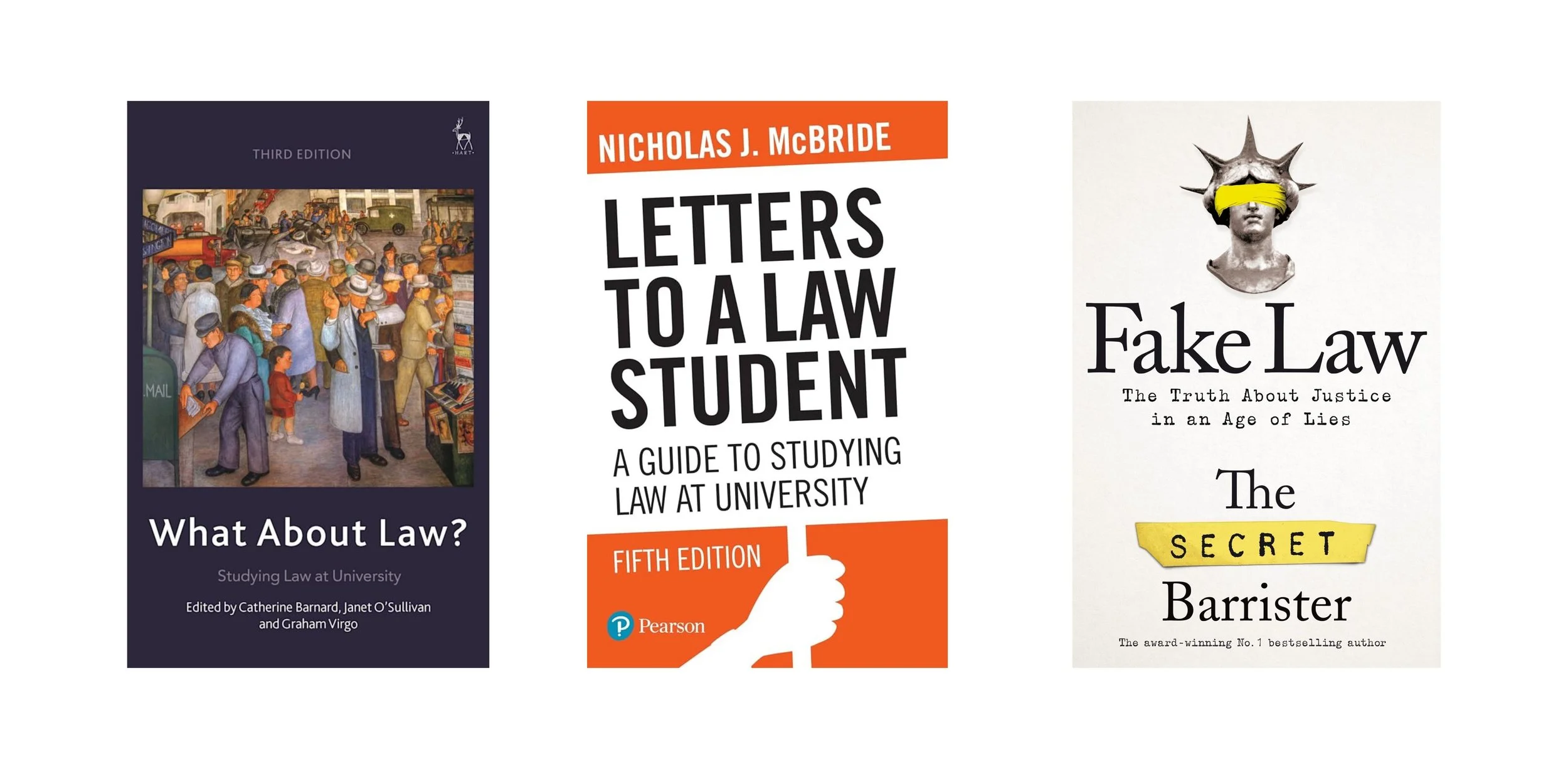
1. What About Law? - Catherine Barnard, Janet O’Sullivan and Graham Virgo
What About Law is one of the most useful starting points because it is written specifically for people who have not yet studied the subject. It details cases and arguments to follow up.
The best way to use this book is to choose a chapter that interests you, find out more about the case discussed and decide whether you agree with the reasoning or outcome. Ask why the judges reached that conclusion and what problems might have arisen if the court had reached the opposite result.
2. Letters to a Law Student - Nicholas J McBride
Letters to a Law Student covers how to construct an argument and approach legal essays, while also discussing issues such as free speech, rights and the harm principle.
A strong way to use the book would be to pick one of the debates introduced and then investigate further. You might ask why individual liberty should be restricted, who determines what counts as harm or whether offensive speech should receive legal protection.
3. Fake Law: The Truth About Justice in an Age of Lies - The Secret Barrister
Fake Law examines popular misconceptions about the legal system and shows how court decisions and legal rules can be distorted by political rhetoric or media reporting.
It is especially useful for prospective Law students because it demonstrates the importance of questioning the way a legal story is presented. If a headline says that judges have reached an absurd decision, you could find the original judgment or a reliable case summary and investigate what the legal question before the court was, what evidence was available, what the judges actually decided and how this differs from the way the case was described publicly.
4. Is Eating People Wrong?: Great Legal Cases and How they Shaped the World - Allan C Hutchinson
Is Eating People Wrong? explores a series of significant legal cases from the UK and other common law jurisdictions, examining not only the judgments themselves but the social circumstances and people behind them.
It is particularly useful for a Law personal statement because it encourages you to question how legal principles develop through individual cases and how courts respond when established rules meet difficult facts. Rather than simply mentioning the book, choose one case that challenged your assumptions and explain whether you found the court’s reasoning convincing.
5. Trials of the State: Law and the Decline of Politics - Jonathan Sumption
For students interested in constitutional law, human rights and the relationship between law and politics, Trials of the State provides plenty to question. Sumption considers the expanding role of courts in deciding contentious social and political issues, raising difficult questions about where judicial power should end and democratic decision-making should begin.
Engaging critically with one of Sumption’s arguments can demonstrate independent thinking and an ability to consider competing principles rather than simply accepting an author’s conclusions.
Example: “A chapter in ‘What About Law?’ led me to think more carefully about the distinction between legal rules and the policy choices underlying them. I became particularly interested in how judges justify decisions where several competing principles appear equally defensible.”
How to Demonstrate the Skills Universities Look for in Law Applications
As a prospective Law student, you may often be told that you need to “think like a lawyer”, but what does thinking like a lawyer actually mean?
Thinking like a lawyer is about how you approach a problem. Good lawyers question assumptions, recognising that apparently simple questions can become much more complicated when different rights, principles or interests come into conflict.
Question Your First Reaction
One of the most useful things you can demonstrate is a willingness to question your initial response to a legal problem. You could deliberately choose an outcome you disagree with and try to construct the strongest argument in its defence. You may ultimately maintain your original view, but the process demonstrates that you are willing to test it.
Example: “Although I was initially critical of the judgment, reading the reasoning made me question whether my objection was really to the court’s interpretation of the law or to the policy consequences of the result, which includes opening the floodgates to a number of similar claims.”
Look for Competing Principles
Legal questions rarely exist in isolation. Often, two individually persuasive principles come into conflict:
Individual liberty vs public safety
Commercial certainty vs fairness
Judicial oversight vs limits of judicial power
Recognising these tensions is a useful way to demonstrate analytical thinking.
Follow an Argument to its Consequences
A good lawyer also needs to consider what follows from a particular argument. This allows you to move beyond whether an outcome seems ‘right’ or ‘wrong’ and consider the wider consequences of legal rules.
Example: “Although allowing the claimant to recover initially appeared to produce the fairest outcome, I began to question whether the same reasoning would remain convincing when applied to less sympathetic claims. This made me interested in the tension between achieving justice in an individual case and creating a legal rule capable of being applied consistently in the future.”
In your personal statement, ‘thinking like a lawyer’ means showing that when you encounter a difficult legal question, you are curious enough to investigate it, analytical enough to test competing arguments and open-minded enough to reconsider your conclusions.
Supercurricular Activities for a Law Personal Statement
Supercurricular activities are one of the best ways to demonstrate that your interest in Law extends beyond school. These might include:
Essay Competitions
Law essay competitions are particularly valuable for a personal statement because they demonstrate independent research, critical thinking and an ability to construct a sustained argument. The Minds Underground Law Essay Competition is an excellent supercurricular activity for students looking to strengthen a Law personal statement. Rather than simply mentioning the competition in your personal statement, use it to discuss the legal issue you explored, the arguments or cases you encountered and how your thinking developed as a result.
Robert Walker (Trinity College, Cambridge)
University Outreach Programmes
University law outreach programmes give prospective students opportunities to attend academic lectures, seminars, workshops and taster sessions led by university academics. Programmes offered by universities can introduce you to unfamiliar areas of Law and university-style legal thinking. In your personal statement, focus on a particular argument or question that interested you and explain how the experience prompted further reading or changed your understanding.
Exploring Law Conference (Cambridge)
ExpLaw (Oxford)
Legal Cases
Reading legal cases and court judgments can provide some of the strongest material for a Law personal statement, allowing you to engage directly with how judges construct arguments and balance competing legal principles. Focus on a case that raises an interesting question, consider the reasoning behind the decision and ask whether you find it convincing. This can demonstrate the analytical and evaluative thinking required to study Law at university.
Podcasts
Law podcasts are an accessible way to explore legal topics beyond the classroom and discover areas of Law you may not previously have considered. For your Law personal statement, choose a particular argument, speaker or issue that interested you and explain how it prompted further thought or research. Following that initial interest through additional reading is especially effective because it demonstrates sustained intellectual curiosity rather than passive participation.
Online Courses
Online Law courses can be a useful supercurricular for prospective Law students, particularly if your school does not offer Law or you want to explore a specific legal field independently. Courses covering areas such as criminal, constitutional, human rights or commercial law can introduce new concepts and provide a starting point for further research. In your Law personal statement, focus on a particular idea that interested or challenged you and explain how you explored it beyond the course itself.
Law Work Experience
Law work experience can strengthen a Law personal statement when you focus on what you learnt rather than where you completed it. Whether through a law firm, chambers, court visit or virtual programme, consider what the experience taught you about how legal principles operate in practice or about a particular area of Law. Admissions tutors are more interested in thoughtful reflection than an impressive firm name, and legal work experience is not essential for a strong application.
The LNAT: Another Important Stage in a Law Application

U2 Tuition’s Law tutors can help students develop an effective approach to the LNAT with targeted practice in comprehension, argument analysis, identifying assumptions and writing clearly under time pressure. These skills complement personal statement preparation by requiring applicants to move beyond simply having an opinion and instead analysing how an argument has been constructed.

Uncertain about what awaits you in the LNAT (Law National Aptitude Test) and looking to enhance your performance?
Preparing for the LNAT can be a daunting task, especially when you're not entirely sure what to expect. However, mastering this test is crucial, as your results can significantly impact your application to top Law courses in the UK.
At U2 Tuition, we've developed an invaluable LNAT Preparation Pack, curated by our best law tutors – all graduates from top UK law courses such as Oxbridge. This comprehensive guide is designed to equip you with the skills and knowledge needed to excel, setting you apart and boosting your chances of success. You'll gain practical insights on confidently presenting yourself and effectively tackling the LNAT.
Key Elements of U2 Tuition's LNAT Preparation Pack:
The first section of our comprehensive guide is tailored to help you understand the structure and expectations of the LNAT. Delve into what each section entails and gain essential tips to optimise your performance.
Navigate the preparation journey for both multiple-choice questions (MCQs) and the essay section. Acquire strategies to maximise your scores in each segment of the LNAT.
Explore current legal and ethical issues, honing your ability to critically analyse and form a well-informed opinion - a key aspect assessed in the LNAT.
Learn how to effectively structure your essay with our model essay plans.
Strengthen your resources with an extra set of 30 past LNAT questions, enhancing your readiness for questions on a wide variety of topics.
Looking for support with your LNAT preparation with mentorship from our top law students and graduates?
U2 has a wonderful network of law undergraduates, graduates, and postgraduates, with extensive experience supporting law applicants through each stage of the process (personal statement, LNAT and interview). Through tutorial sessions, they'll guide you through critical discipline areas, bolster essay writing skills, and navigate LNAT strategies. Learn more via our Law Applications page and to discuss your specific application and how we can support, book a free consultation via our Contact Us page.
How U2 Tuition Can Help With Your Law University Application
A competitive Law application involves more than producing a polished personal statement. Applicants need to develop genuine academic interests, decide how best to demonstrate them and, for many universities, prepare for additional stages such as the LNAT and interviews.
At U2 Tuition, our Law admissions support is tailored to the individual student and the universities they are targeting. Our tutors are highly experienced in the university admissions process and can support students throughout their application, from identifying areas of Law they would like to explore to preparing for an Oxford or Cambridge Law interview.
Develop Your Ideas Before You Start Writing
Some students come to us with a clear interest in a particular area of Law. Others know that they want to study the subject but are less certain about exactly what interests them. Both are completely normal starting points.
A good tutor can help a student explore these interests rather than imposing an artificial theme on their application. This might involve suggesting books, cases, lectures, podcasts or essay competitions. Over time, these conversations can help students identify the intellectual interests that will eventually form the strongest parts of their personal statement. The result is a personal statement that is more analytical and, importantly, more individual.
Personal, One-to-One Law Admissions Tuition
U2 Tuition places considerable emphasis on matching students with tutors who understand both the academic demands of Law and the particular admissions process they are preparing for.
Sessions are conversational and intellectually stimulating. A tutor can question an argument in the same way an academic might, point out where an idea has been asserted without sufficient reasoning, recommend further exploration and help the student recognise where an apparently simple point could be developed into something much stronger.
Law Interview Preparation and Mock Interviews
For students applying to Oxford or Cambridge, personal statement preparation forms only one part of a much wider admissions process.
U2 Tuition can provide one-to-one interview preparation and realistic mock interviews. Applicants may be given a new scenario, legal principle or argument and asked to reason through it. Our tutors can help students become more comfortable with this style of questioning. Mock interviews provide an opportunity to practise thinking aloud, responding to challenges, reconsidering an initial answer and developing an argument when new information is introduced.
Frequently Asked Questions
What should I include in a Law personal statement?
Focus on why you want to study Law, how your academic work has prepared you, and what you have done outside school to deepen your interest. Wider reading, essay competitions, lectures, current affairs and legal work experience can all be useful if you reflect on them.
Do I need legal work experience?
No. Legal work experience can be useful, but it is not essential for an undergraduate Law application. Universities understand that access to firms and chambers is uneven. A thoughtful reflection on a case, book or essay competition can be more valuable than prestigious work experience described superficially.
How many books should I mention?
There is no ideal number. Depth matters more than quantity. Choose books which you genuinely enjoyed and those which allow you to link to other activities you have completed in preparation for your application.
Should I mention extracurricular activities?
Yes, but selectively. Sport, music, volunteering, part-time work and leadership roles can show useful qualities, but they should not dominate an academically focused Law statement.
Should I mention Oxford or Cambridge directly?
Your UCAS personal statement should work across all of the universities to which you are applying. Focus on your interest in Law rather than tailoring the entire statement to one institution.
How do I start a Law personal statement?
A strong Law personal statement should start with a specific legal question, issue or idea that genuinely interests you. Introduce an area of Law that has prompted you to think critically, then explain how reading, a case, current affairs or another experience developed that interest. Your Law personal statement introduction should give admissions tutors an immediate sense of why you want to study Law.
What makes a Law personal statement stand out?
The best Law personal statements demonstrate intellectual curiosity, critical thinking and genuine engagement with Law beyond the classroom. Rather than listing books, work experience or supercurricular activities, explain what you learnt from them, which arguments you questioned and how your thinking developed. Specific, thoughtful reflection will usually make your application more memorable than trying to include as many achievements as possible.
Should I mention the LNAT in my personal statement?
You generally do not need to mention the LNAT in your Law personal statement. Universities that require the LNAT receive your results separately, so valuable personal statement space is usually better used demonstrating your academic interest in Law.
Do I need to have studied Law at A-Level?
No. You do not need Law A-Level to study Law at university, and universities do not generally expect applicants to have studied the subject previously. Subjects such as History, English, Politics, Languages, Sciences and Mathematics can all develop skills relevant to a Law degree, including critical analysis, logical reasoning and constructing arguments. In your Law personal statement, focus on how your studies have prepared you academically and how you have explored Law independently beyond the school curriculum.