

TMUA Explained: Format, Scoring, Universities & How to Prepare
Oxford University has announced a move away from MAT towards TMUA for admission to selected courses from the 2026-2027 admissions cycle, aligning with a broader shift across top UK universities.

Contents
What is the TMUA exam, and why do universities use it?
The Test of Mathematics for University Admission (TMUA) is a national admissions test used mainly by UK universities for mathematically demanding degrees such as Mathematics, Computer Science, Economics, and Engineering.
TMUA exists because A-levels often cannot differentiate between strong and exceptional mathematical thinkers. With very high grades common among applicants, universities need a tool that reveals how students think, not just what they have been taught.
It enables universities to:
Identify applicants who can reason carefully under unfamiliar conditions
Compare students from different schools, exam boards, and countries
Reduce reliance on predicted grades when making offers
How is the TMUA different from A-Level Maths?
It’s wrong to assume the TMUA is “just A-level content”.
Unlike Maths A-Level, the TMUA tests students’ ability to interpret dense mathematical language and problem-solve in unfamiliar settings.
There is no routine procedure, nor a standard question format
Students must utilise logical reasoning and precision
They must also draw on consistency and stamina over long stretches of thinking
Questions are deliberately designed to make candidates think outside the box, unlike A-Level exams, which often use standard techniques.
If you’re looking to take your TMUA preparation to the next stage, get in touch with us to learn more about our tailored, expert support.
TMUA format: how the exam actually works
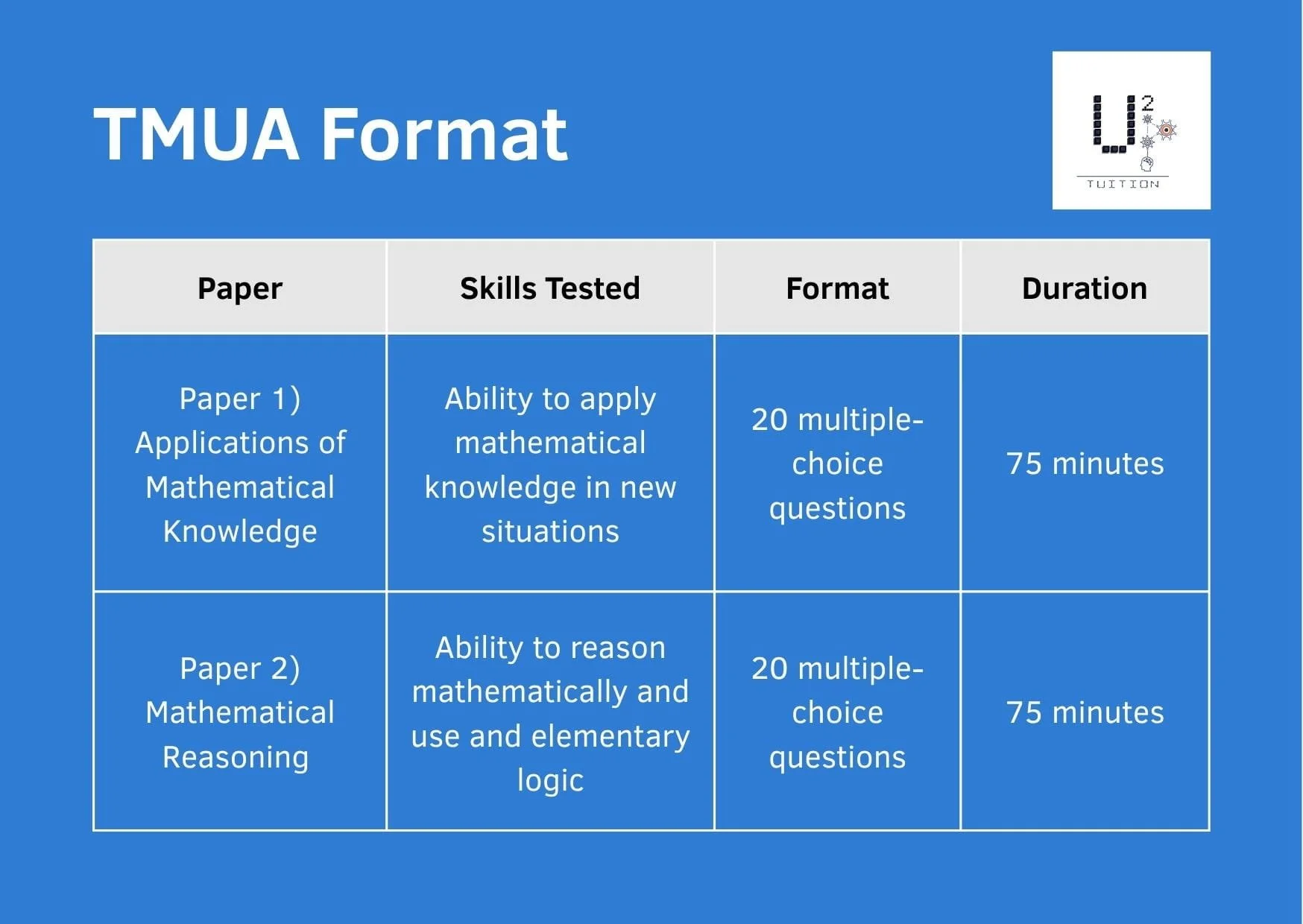
The TMUA consists of two papers sat on the same day, each lasting 75 minutes.
Questions are multiple choice, with some options designed to reflect common errors.
Each paper typically has 20 questions.
No calculators are allowed, forcing candidates to use reasoning rather than approximation to reach answers.
Generally, the calculations are straightforward, but the logic and thought process behind them is not.
Common misconceptions about the TMUA
The TMUA is not:
The same as Further Maths A-Level
It does not rely on advanced content, but rather on complex reasoning and problem-solving.
You also don’t need to have studied Further Maths to do well at the TMUA, especially given its focus on reasoning abilities rather than depth of knowledge.
How you think is often more important than what you know.
The MAT
The MAT was more proof-oriented, featuring complete written solutions rather than just multiple-choice questions.
Assessing fast calculations
It doesn’t involve fast calculations; often, the calculations are relatively straightforward, but the thought process behind them is complex.
Cramming does not work for preparing for TMUA, as the exam rewards pattern recognition built over time, not just short-term memorisation.
Why not use a tutor to ensure your TMUA preparation is effective and maximise your chances of a good score? Book a complimentary TMUA consultation to learn more.
TMUA scoring explained: what is a good score?
TMUA is scored on a 1 (low) to 9 (high) scale, in increments of 0.1.
Most scores fall between 4.0 and 6.5; scores above 6.5 are generally considered strong, and those above 7 are excellent.
Universities use TMUA results in several ways, including shortlisting applicants and, sometimes, as a direct part of the offer.

Which universities require the TMUA?
Imperial
TMUA is required for degrees in Computer Science, Maths, and Economics, Finance and Data Science
London School of Economics and Political Science (LSE)
TMUA is compulsory for Economics, Econometrics, and Mathematical Economics
It is recommended for several other Economics, Maths, Finance, and Data Science degrees
University College London (UCL)
Compulsory for Economics
University of Cambridge
Compulsory for Computer Science and Economics
University of Oxford
From the 2026-2027 admissions cycle, Oxford will require applicants to the following courses to take the TMUA:
Computer Science
Computer Science and Philosophy
Mathematics
Mathematics and Statistics
Mathematics and Computer Science
Mathematics and Philosophy
University of Warwick
Compulsory (except for those eligible for a contextual offer) for several courses in Maths and Computer Science
Recommended for Data Science, Economics, and some other Maths courses
TMUA vs MAT: what’s changed and why it matters
In January 2026, Oxford announced the decision to replace the MAT (Mathematics Admissions Test) with the TMUA for admission to Maths, Computer Science, and joint honours courses from the 2027 entry. This means Oxford will use the TMUA for the first time in the 2026-2027 admissions cycle.
So, what are the main differences between the TMUA and the MAT?
The TMUA focuses on breadth of reasoning across many questions, while MAT focuses on depth of reasoning within fewer problems.
MAT is sat in a single 2-hour 30-minute sitting, whereas TMUA is spread across two much shorter papers, making it more time-pressured.
This also means TMUA requires rapid interpretation and decision-making, whereas MAT requires more structured proof, particularly for longer questions.
TMUA is generally more accessible to non-Further Maths students, provided they prepare correctly.

How to prepare for the TMUA effectively
To prepare for TMUA, students could follow the following steps:
Build familiarity with question language and structure
Practice untimed, focusing on reasoning clarity
Gradually introduce time pressure
Analyse patterns across questions and papers
An ideal timeline for preparation is 6-9 months, with a focus on quality over quantity. Timed papers should only be introduced once accuracy is stable. Past papers should be used sensibly to identify weaker areas.
Doing too many papers without analysing results can lead to plateauing.
The following preparation resources should be employed:
UAT-UK’s notes of TMUA Paper 1 and TMUA Paper 2
Rich resources that offer guidance on specification, example solutions, and exercises for you to practice.
These date back to 2016, and there are also some specimen papers.
Worked answers are provided for all papers.
University of Warwick Mathematics Institute TMUA Support & Links
Alongside advice about the TMUA, Warwick Maths Institute offered video walkthroughs for individual questions, handwritten solutions, and links to further support.
Foundation modules of the STEP (Sixth Term Examination Papers)
Although the format and content differ, they are still an excellent means to practice using your Maths skills under timed conditions.
In fact, STEP requires students to utilise AS-level, A-level, and even Further Maths skills (for STEP 3), so effective use of these resources ensures students are well prepared for TMUA content, which primarily focuses on AS-level Maths.
Similar usage of MAT past papers
The Oxford Maths department website offers specimen papers and past papers going back to 2007. Their solutions and feedback on that year’s performance are also provided.
This is a good way to learn what traps candidates often fall into, so you can avoid them.
Again, whilst the content and format differ slightly, the MAT also mainly uses multiple-choice questions, and the papers provide students with more practice opportunities.
Here’s the 2025 MAT Paper and its solutions.
U2 Tuition’s Oxford MAT Preparation Guide contains relevant preparation points and tips.
U2 Tuition’s Oxbridge-educated tutors provide their own bespoke resources to support TMUA preparation. Contact us to find your TMUA tutor.
How TMUA preparation should differ by student profile
Students who have studied Maths only, not Further Maths, need early exposure to unfamiliar problem styles and logical reasoning. This is something not covered so much in the traditional A-Level syllabus, so further practice is often required.
Students who have studied both Maths and Further Maths should avoid overly technical approaches. They should instead focus on finding the quickest and most elegant solutions to questions to ensure efficiency.
International students often need to improve their mathematical English and interpretation skills, as questions can be wordy and use technical language.
IB students usually benefit from TMUA’s emphasis on reasoning, but they should also focus on the speed required to answer the questions. This is best done by completing practice papers and questions in timed conditions.
What high-scoring students do differently

Top-performing students often practice slowly and carefully at first, focusing on understanding the solutions rather than finishing quickly.
They review mistakes in detail, identifying whether errors were conceptual, logical, or due to misreading and then paying greater attention to the area that needs improving.
In addition, high-achieving students start their preparation early, often 6-9 months before the exams.
TMUA Preparation Pitfalls
Students are likely to struggle with TMUA if
They rely heavily on memorised methods and struggle to solve problems in unfamiliar contexts.
They focus on the volume of practice questions done, rather than ensuring a complete understanding of each question.
They wait until close to the exam to begin timed practice.
They find it challenging to interpret wording quickly or to manage timing in exams in general, as TMUA requires a fast pace of thought.
Preparation should focus on accuracy, stamina, and careful review of question wording and mistakes. Give yourself plenty of time to get used to the speed required to answer questions.
Advice from Kira, a Cambridge Maths Graduate
The hardest part of TMUA is rarely the maths itself, but rather the way candidates approach questions. Strong students can often struggle because TMUA disrupts familiar habits, since recognising a method and applying it quickly is not enough. Questions are usually designed so that the obvious first approach is incomplete unless assumptions are checked carefully. Precision in reading matters more than technical fluency, as a single word can change the logic, and many errors can come from thinking faster than reading.
Some advice many students wish they had heard earlier is that slow thinking is not wasted time. The strongest performers pause at the start of a question to clarify what is being asked and what must be true before doing any calculations. TMUA rewards accuracy, and attempting fewer questions well is often a better strategy than rushing to try everything.
Another lesson students often learn too late is that TMUA can test habits. Many wrong answer options reflect a specific misconception, and analysing why a choice is wrong is as valuable as finding the correct one. Successful preparation changes how students read and reason, helping them become more deliberate, more sceptical of first impressions and more comfortable sitting with uncertainty before committing to an answer.

TMUA tutoring – Why choose U2 Tuition
To ensure your best chances at a strong TMUA score, our Oxbridge-educated TMUA expert tutors are here to help. Our tutors offer:
TMUA-specific expertise, not generic maths tutoring
TMUA success depends on reasoning style, question interpretation, and exam strategy. Our tutors are familiar with the exact demands of the TMUA and how universities use the results.Focus on how marks are really gained (and lost)
We help students recognise common traps, misleading answer options, and subtle wording changes that often differentiate strong candidates from average ones.Structured preparation, not cramming
TMUA rewards pattern recognition developed over time. Our tutors design preparation plans that build familiarity gradually, introduce time pressure at the right stage, and avoid burnout.Targeted use of past papers
Past papers are used diagnostically, not mechanically. Tutors guide students through analysing mistakes, understanding why incorrect options are tempting, and refining decision-making.Feedback on your performance is central to developing your TMUA abilities. The extensive resources available may offer solutions, but not in-depth explanations or advice on your answers and way of working. Tutoring is a great way to compliment this.
Support for different student backgrounds
Whether a student has studied Maths only, Maths and Further Maths, IB, or an international curriculum, tutoring is adapted to address their specific strengths and gaps.Clear, honest guidance on scoring and competitiveness
We help students understand their target score for their chosen universities and how TMUA fits into the wider admissions process.
Book a complimentary TMUA consultation to discuss preparation strategy and timelines.
TMUA FAQs
What does TMUA stand for in UK education?
TMUA stands for the Test of Mathematics for University Admission. It is a national admissions test used by UK universities to assess mathematical reasoning and problem-solving ability beyond school examinations.
Which UK universities require the TMUA?
The TMUA is used by several mathematically demanding courses across the UK, including at Cambridge, Imperial, UCL, Durham, Warwick, and, from the 2027 entry cycle, Oxford for selected courses.
Requirements vary by course and year, so applicants should always check individual university guidance.
Does Oxford accept the TMUA?
Yes. Oxford has announced that it will replace the MAT with the TMUA for Mathematics, Computer Science, and joint honours courses for 2027 entry onwards. This means TMUA will be used in the 2026–27 admissions cycle.
Is TMUA harder than the MAT?
It has been suggested that the MAT is harder than the TMUA. This is because the MAT requires students to answer questions requiring both AS and A-Level Maths, whereas the TMUA question topics are primarily based on AS Maths.
The TMUA is also entirely multiple-choice, whilst the MAT has two longer questions along with 25 multiple-choice questions. The TMUA does have 40 multiple-choice questions across its two papers, so it is more demanding in terms of speed, breadth, and precision.
Both tests are challenging and require effective preparation. Neither is “easier”; overall, they reward different skills.
Is TMUA harder than A-level Maths or Further Maths?
Yes. While TMUA content is based chiefly on AS-level Maths, the difficulty lies in the reasoning, interpretation, and unfamiliar problem presentation. Strong A-Level or Further Maths grades do not automatically translate into strong TMUA performance without targeted preparation.
What is a good TMUA score?
TMUA is scored on a 1.0 to 9.0 scale.
Scores between 4.0 and 6.5 are typical
Scores above 6.5 are considered strong
Scores of 7.0 or above are excellent and highly competitive for top universities.
What counts as a “good” score depends on the course and institution.
Is 7.5 a good TMUA score?
Yes. A score of 7.5 is an excellent TMUA result and places a candidate among the strongest performers nationally. It is highly competitive to gain admission to universities such as Oxford, Cambridge, Imperial, and Warwick.
How hard is it to get a 7 or above in TMUA?
Achieving a 7+ score is challenging and typically requires months of structured preparation. Students who reach this level usually start early, analyse mistakes carefully, and practise reasoning under time pressure rather than relying on memorised methods.
Is the TMUA a non-calculator exam?
Yes. No calculators are allowed in the TMUA. This is deliberate: the test prioritises logical reasoning, clarity of thought, and accuracy over numerical approximation.
Where can I find TMUA past papers with solutions?
Official TMUA past papers and specimen papers are available through UAT-UK, with worked solutions provided. Additional support materials and walkthroughs are available via some university mathematics departments, such as Warwick.
How do I register for the TMUA?
Registration can be done via the UAT-UK Website. Details on registration and booking dates are typically released in April. Applicants from the UK and the Republic of Ireland must pay £75, whilst applicants from elsewhere must pay £130. The test is sat at Pearson VUE Test Centres.