

The TSA (Thinking Skills Assessment) will be replaced by the TARA (Test of Academic Reasoning for Admissions) for Oxford courses from 2027 entry onwards. The change will come into effect from the 2026 admissions cycle. The skills assessed remain highly similar: critical thinking, problem-solving and academic reasoning. This course has been fully updated to reflect the new TARA format.
TARA (formerly TSA) Oxford Preparation Course
Our TARA (formerly TSA) preparation course supports Oxford applicants in developing the advanced reasoning and critical thinking skills required for competitive admissions.
The Test of Academic Reasoning for Admissions (TARA) serves as a crucial evaluation tool for applicants applying to a range of top courses, including Economics & Management, Human Sciences, PPE (Philosophy, Politics and Economics), Psychology (Experimental), and Psychology, Philosophy and Linguistics (PPL).
Our online TARA admissions test course is designed to equip students with the skills and strategies needed to excel on the TARA exam. Through expert guidance and targeted practice, our TARA preparation course ensures that students are thoroughly prepared to tackle the challenges of the TARA test and confidently pursue their academic aspirations at Oxford.

What to Expect from the TARA (Formerly TSA) Prep Course
The TARA (Test of Academic Reasoning for Admissions), which replaces the TSA for Oxford entry from 2027 onwards, is a fast-paced critical thinking and problem-solving exam. The core skills assesed remain highly similar to the TSA and the format is not entirely different.
The TARA admissions test evaluates how clearly and efficiently students think under time pressure. It is designed to test reasoning ability, not subject knowledge, across a range of Oxford courses.
In these classes, students will cover all major question types in the TARA, focusing on the most challenging areas and the specific techniques needed to approach them strategically. By the end of the course, students will have a comprehensive toolkit to tackle the TARA with confidence and precision.
Our Hosts: TARA Admissions Test Specialists
Our TARA (formerly TSA) course is delivered by specialist tutors from Oxford courses that require the TARA admissions test, including PPE and related disciplines.
All of our hosts are experts in admissions test preparation, with extensive experience teaching the strategic reasoning, critical thinking and problem-solving skills required for success in the TARA.
They have supported students to successful Oxford entry across a range of competitive courses, both through private mentoring and small-group programmes. Each tutor is highly experienced in teaching exam technique, time management and structured essay responses specific to the TARA format.
Students benefit from tutors who understand not just the content of the test, but the mindset and approach required to perform at the highest level.
TARA Course Logistical Details
The TARA course is run online over Zoom. International students are welcome to join.
The TARA course runs over two weekends over the UK summer holiday period.
Each class is 2 hours in duration.
Sessions are highly interactive, not lectures.
The TARA course host will set optional tasks between classes to ensure students consolidate material and elevate their performance as much as possible.
Sessions can be recorded in case a student is away for a particular class and would like to catch up.
U2 Tuition specialises in top UK University and Oxbridge applications, with Oxbridge tutors available in all degree courses. We provide one-to-one TARA (formerly TSA) preparation, alongside the group TARA course. The group TARA course is designed for short-term intensive preparation over the summer period, but many students also choose to take on a 1-1 TARA tutor to provide them with the essential skills prior to this booster course or to further hone their individual TARA performance. We also provide personal statement and interview preparation. Get in touch with us to arrange this if of interest.
TSA Course Components
The TARA (formerly TSA) assesses very similar core reasoning skills, but the structure has changed.
All candidates now sit three components:
Critical Thinking - 22 MCQs (40 minutes)
Problem Solving - 22 MCQs (40 minutes)
Writing Task - maximum 750 word essay (40 minutes)
Rather than interspersed question types, Problem Solving and Critical Thinking are now separate sections.
The Writing Task is longer than under the TSA (40 minutes) and has a maximum word count of 750 words. It is now mandatory for all TARA candidates.
Our course prepares students comprehensively for each section, equipping them with the techniques and structure required to perform confidently under timed conditions.

Session 1 (Critical Thinking: Conclusions, Assumptions, and Flaws)
In this class, we’ll look at some of the more straightforward critical thinking questions: identifying and drawing a main conclusion, and assessing the impact of additional evidence. Through looking at specific questions, we’ll methodically identify the premises and conclusions of an argument, enabling us to either identify or find the conclusion. Utilising this technique of identifying premises and conclusions, we will then look at the more difficult assumptions and flaws questions.
While these are two different types of questions, they are a natural pairing, as an unstated assumption is almost the same as a flaw in an argument. If we can find a reason to doubt an assumption, it’s a flaw in an argument. Again, by focussing on a premises and conclusion structure, we will be able to identify the gaps in the reasoning, and thus discover unstated assumptions and flaws in the argument.

Session 2 (Critical Thinking: Strengthening & Weakening, Matching Arguments, and Applying Principles)
The aim of this session is to cover the remaining question-types in critical thinking, beginning with questions that ask for further evidence that would support or weaken the argument. Having completed Session 1, students should now be well-equipped to identify conclusions, and therefore work out how further information would affect the strength of those conclusions.
We will then look at 'Matching arguments’ questions, which require us to identify arguments that have parallel structures. With these questions, we will learn to systematise the parallels, through reducing the arguments down to If/then statements, and through alternative methods, such as set theory.
With ‘Applying principles’ questions, our job is to work out on what grounds the argument is given: for example, an argument for vegetarianism might be grounded in cruelty to animals. We then have to identify a similar argument that is also grounded in cruelty to animals. As with previous question types, by recognising premises and conclusions, we can see what is the operative principle at work, and therefore find our way to the answer.

Session 3 (Problem solving: Relevant Selection and Identifying Similarity)
The problem solving questions are both more straightforward and more challenging than the critical thinking questions. While they often utilise maths (something students are familiar with), they often do so in a way that requires lateral thinking and mental gymnastics. In this first class on problem solving, we’ll focus on ‘Relevant selection’ and ‘Identifying similarity’.
With both these question types, the TSA likes to overwhelm the examinee with a lot of extra information – our job is to cut through the noise and only focus on the important information. Through looking at a series of questions, we’ll work on strategies to hone in on relevant information, and how we can relate seemingly disparate information (such as a graph and paragraph) to come to a methodically reasoned answer.
Session 4 (The Writing Task)
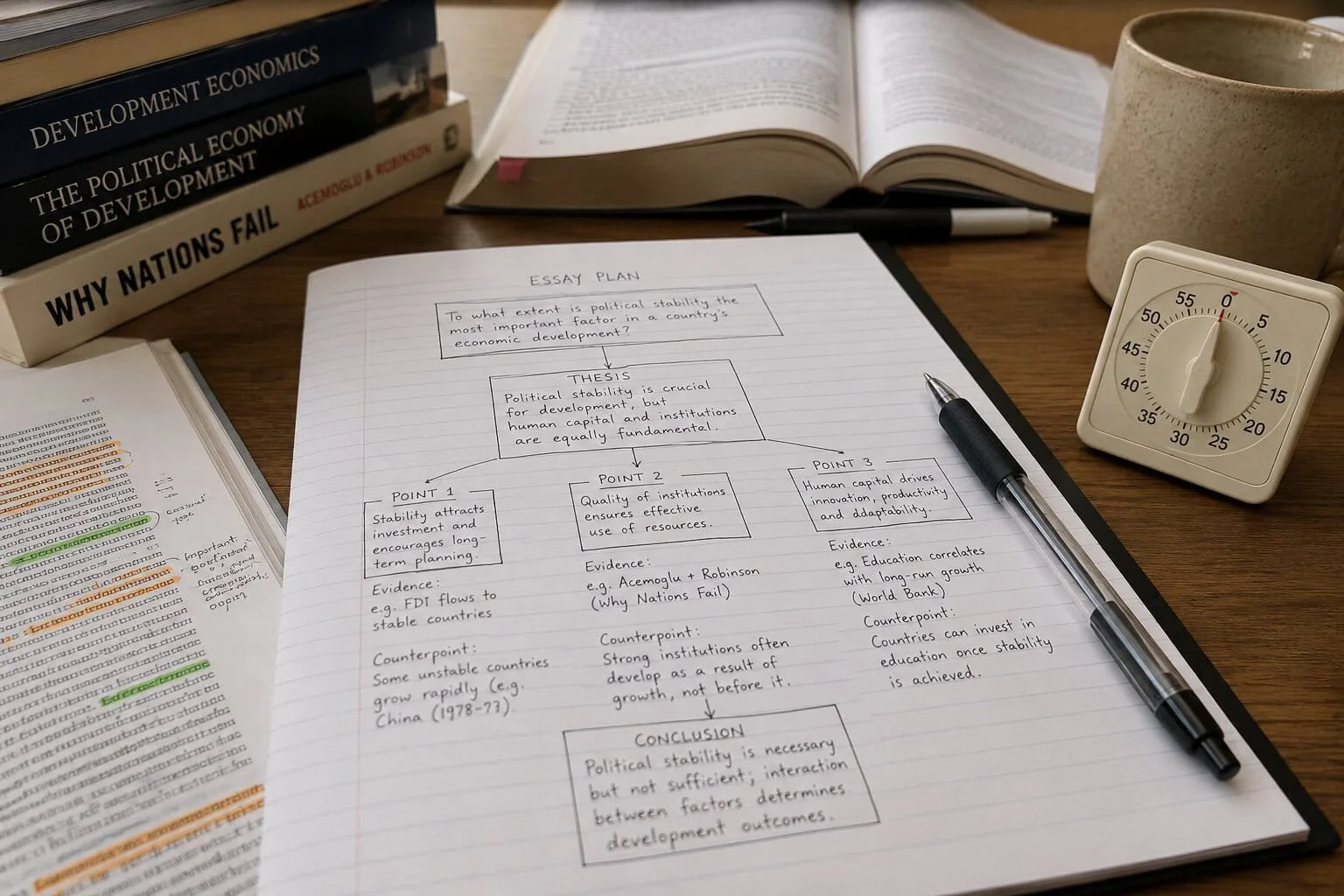
The final session focuses entirely on the writing task, where candidates must construct a clear, persuasive, and well-structured essay under strict time constraints. Success in this section relies on a student's ability to dissect a complex prompt and methodically address its core components: explaining the statement, constructing a robust counterargument, and delivering a nuanced personal assessment.
Using real past prompts - such as Alexander Pope’s maxim "A little learning is a dangerous thing" - we will break down the anatomy of a top-scoring essay. Students will learn strategies to build a bulletproof thesis, organise their arguments logically, and manage their time efficiently during the planning phase to deliver an academically rigorous response.
Frequently Asked Questions (FAQ) for the TSA Course
What is the TARA test?
The TARA (Test of Academic Reasoning for Admissions) is Oxford's admissions test, replacing the TSA from 2027 entry onwards. It will first be employed during the 2026 admissions cycle. It assesses critical thinking, problem-solving and structured written reasoning under timed conditions. Many families still refer to the TSA, but the core skills assessed remain highly similar.
Which courses require the TARA test?
A range of Oxford undergraduate courses require the TARA admissions test. These include Philosophy, Politics and Economics (PPE), Economics and Management (E&M), History and Economics, Experimental Psychology, Human Sciences and related disciplines.
Previously, some subjects, such as E&M, were exempt from the writing task. All candidates now sit all three components of the TARA.
How does your TARA course help with preparation?
Our TARA course prepares students for all components of the test: Problem Solving, Critical Thinking and the Writing Task. We focus on strategic reasoning methods, efficient time management and structured argument development tailored to Oxford's assessment style.
What does the Problem Solving section involve?
The Problem Solving section consists of 22 multiple-choice questions in 40 minutes. It tests numerical reasoning, data interpretation and logical problem-solving under time pressure. Students are encouraged to attempt all questions as marks aren't deducted for incorrect answers.
What does the Critical Thinking section involve?
The Critical Thinking section also includes 22 multiple-choice questions in 40 minutes. Students analyse arguments, identify assumptions, and evaluate the accuracy of reasoning. A strong technique is essential for efficient performance.
What does the Writing Task involve?
The Writing Task is a 40-minute essay component with a maximum word count of 750 words. All TARA candidates must complete it. Students are assessed on clarity of reasoning, structure and argumentative precision.
Are practice materials included in the course?
Yes. Students receive extensive practice questions, timed drills and structured essay guidance to build familiarity with the format and demands of the TARA admissions test.
How long is the TARA course?
The course runs over two weekends, with two-hour sessions on both Saturday and Sunday. It is designed as a strategic booster programme to enhance independent preparation. Many students also opt for 1-1 TARA mentoring for more personalised support.
How can I enrol in the TARA course?
To enrol, click the "Date and Pricing" button on this page and follow the registration instructions.