

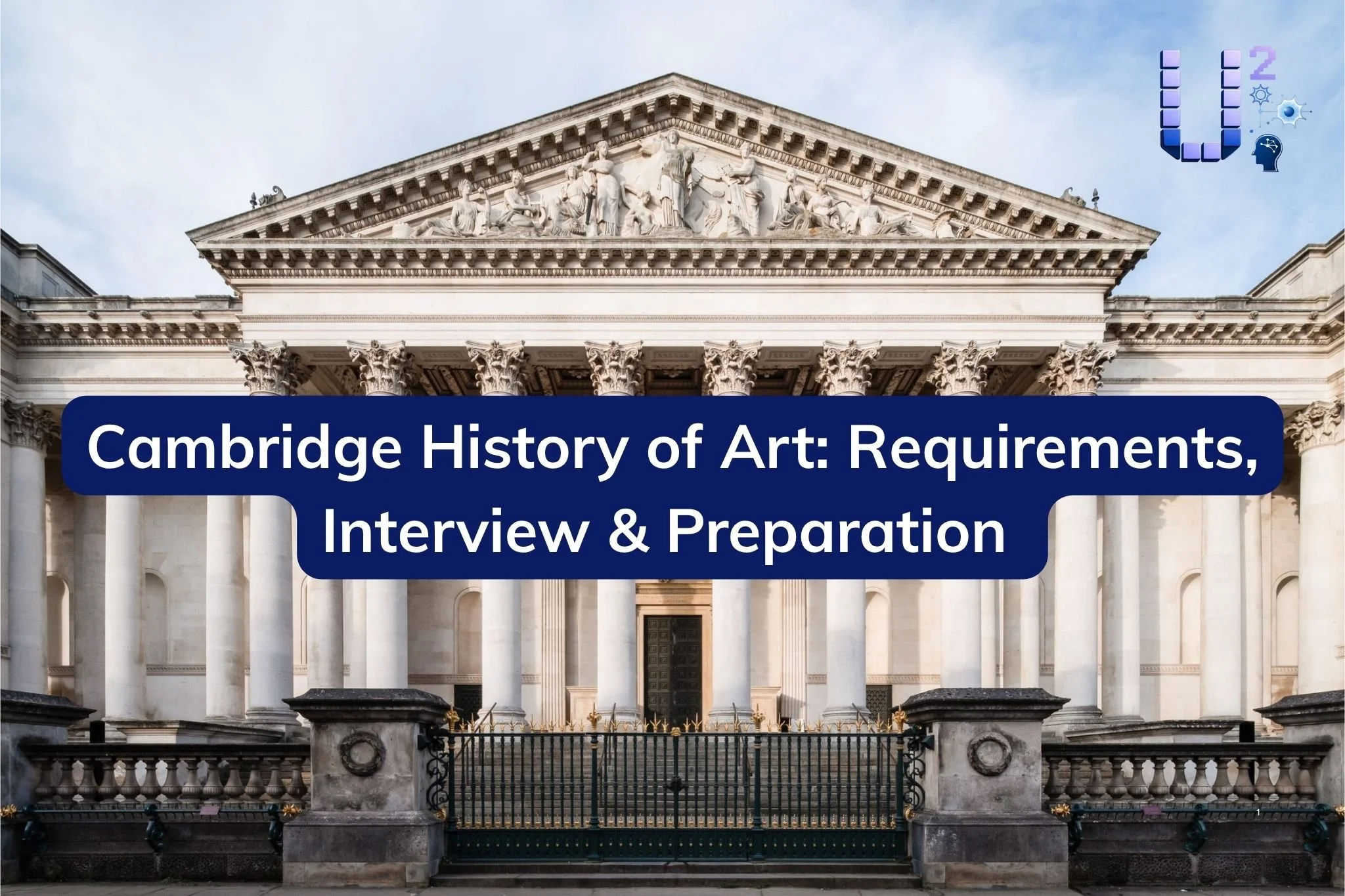
Cambridge History of Art: Requirements, Interview & Preparation
Contents:
Why choose History of Art at Cambridge?
Cambridge History of Art Entry Requirements FAQs
How is the Cambridge History of Art course structured?
Writing a Cambridge History of Art personal statement that stands out
How to prepare for your Cambridge History of Art interview
U2’s tailored Cambridge History of Art application support
Why choose History of Art at Cambridge?
With just 31 students accepted in 2025 and around 5 applicants per place, History of Art is one of the smallest courses at the University of Cambridge.
It is also one of the most distinctive. The Cambridge History of Art degree is designed for students who enjoy looking closely, thinking carefully and building arguments about what they see. It suits those who are curious about visual culture and keen to explore ideas through discussion.
Studying History of Art at the University of Cambridge offers a uniquely immersive experience, where teaching is grounded in direct engagement with world-class collections.
From the first year, students regularly work with artworks and objects in spaces like the The Fitzwilliam Museum, Kettle’s Yard, and the The Women’s Art Collection, developing the close observation, analytical precision, and confidence in discussion that Cambridge prioritises. At U2 Tuition, our tutors have studied at Cambridge or worked within these institutions and can help students build these exact skills, giving them a clear advantage in both the application process and the course itself.
A common misconception is that you need extensive prior knowledge. In reality, what matters far more is how you think.
Strong applicants are those who can observe, question and interpret with clarity. This is something that can be developed, and the earlier you begin practising it, the stronger your application becomes.
If you’re considering applying, it’s worth getting an early sense of how your current profile compares. We often start with a diagnostic sessionto map out a clear preparation plan.
Cambridge History of Art Entry Requirements FAQs
What A-Levels are needed?
There are no fixed subject requirements. However, most successful applicants take essay-based A-Levels such as:
History
English Literature
Classics
Cambridge is primarily looking for strong critical thinking, visual analysis skills and essay-writing skills.
What grades do you need?
The typical offer is A*AA at A-Level.
What is the typical IB offer?
The standard IB offer is:
40–42 points overall
776 at Higher Level.
Do all colleges offer History of Art at Cambridge?
You can study History of Art at all colleges, with the exception of Girton and St Catharine's, which do not offer the course.
What is the acceptance rate?
History of Art is one of the smallest courses at Cambridge, with:
Around 31 students admitted per year
5 applicants per place
A 20-22% acceptance rate
Do I need to take an admissions test?
No, currently there is no standard admissions test required.
Is submitted work required?
Yes. Most colleges require 1–2 pieces of written work.
This is usually school essays that demonstrate your ability to analyse, argue, and write clearly.
How is the Cambridge History of Art course structured?
The History of Art BA at Cambridge is divided into Part 1 (first year) and Part 2 (second and third year).
In Year 1, you’re introduced to a wide range of art and architecture. The focus is on learning how to analyse what you see and build arguments.
In later years, you specialise and develop your own ideas in greater depth.
How U2 can help:
Our tutors train students in the skills the course demands:
Visual analysis: noticing and interpreting detail
Argument building: turning observations into strong points
Discussion: expressing ideas clearly and confidently
Our History of Art Summer School (July–August) is designed to give students early exposure to exactly this way of working.
Led by Oxbridge-educated art historians, it introduces:
First-year university-style material
Guided analysis of artworks
Small-group discussion and feedback
Students come away not just with stronger knowledge, but with a clear sense of how to think and respond at a higher level.
Writing a Cambridge History of Art personal statement that stands out
A strong History of Art Cambridge personal statement shows how you think, not just what you have done.
The most compelling statements tend to:
Analyse specific artworks in detail
Draw on independent reading or research
Reflect thoughtfully on exhibitions or visual experiences
Weaker statements often describe rather than analyse.
For example, saying you are interested in Renaissance art is not enough. What matters is how you interpret it:
What do you notice about composition or material?
How do you understand its context?
What questions does it raise?
Developing this level of analysis takes time. The strongest applicants are usually those who have drafted and refined their thinking further, rather than rushing the process at the end.
This is an area where targeted feedback makes a real difference. We work closely with students to refine their personal statements, focusing on depth of analysis rather than surface-level description.
How to prepare for your Cambridge History of Art interview
The Cambridge History of Art interview is designed to explore how you think, not what you already know.
For example, you might be shown an unfamiliar artwork and be asked to respond to it, or to expand on something you have written in your personal statement.
Interviewers may challenge your interpretation to see how you respond, or whether your opinions have changed since writing your statement a couple of months prior to the interview.
They are looking for:
Clear and structured thinking
An openness to new ideas
The ability to justify your views and genuine curiosity
Interviews take place online in early December. We run tailored mock interviews in November that replicate this process closely, helping students become comfortable thinking out loud and responding to challenging questions.
U2's tailored Cambridge History of Art application support
At U2, we provide:
Standout Application Strategy
From choosing the right college, to shaping a coherent and competitive application narrative, we can help you position your academic profile effectively.Tailored Personal Statement Advise
At U2, our tutors go beyond generic advice. They help you engage with exhibitions, dense texts and current art news and ideas so your personal statement reflects genuine intellectual curiosity and depth.Written Work That Scores Highly
Your submitted essays are often decisive. Our U2 tutors can refine your work to meet Cambridge History of Art standards, paying close attention to your approach to visual analysis.Interview Preparation That Mirrors Cambridge
Through mock interviews and image-based discussion, we train you to think out loud. Our tutors can guide you through unfamiliar works and help you grow to respond with confidence under pressure.Mentors Who Know the Course First-Hand
Because our tutors have studied History of Art at Cambridge, they bring essential insight and first-hand knowledge of seminars held at institutions like the The Fitzwilliam Museum and Kettle’s Yard.Flexible, High-Impact Support
Sessions can be online, in person or hybrid. We will design your sessions around your schoolwork while maximising progress.
Ready to get started? Check out U2’s History of Art Guide!
Our 33-page guide focuses on how to prepare to ensure you stand out and increase your chances of success, as includes a number of tips on crucial communication skills for the interview.
U2’s History of Art Graduates guide you on:
Don’t know what to expect for your Oxbridge History of Art interviews?
Oxbridge interviews can feel overwhelming to prepare for. However, they are a great opportunity to present yourself and show your motivation and enthusiasm to your potential future tutors.
This essential guide, prepared by U2's History of Art tutors, all of whom are Oxford or Cambridge History of Art graduates will walk you through how to prepare to ensure you stand out and increase your chances of success, as well as a number of tips on crucial communication skills for the interview.
Core components of U2 Tuition's Oxbridge History of Art guide:
The first section of our 33-page guide focuses on helping you demonstrate a broad exploration of History of Art o showcase your passion and motivation. Our History of Art graduates guide you on what to read (both primary and secondary material), how to cite key texts, and how to use online resources such as podcasts to justify your reasoning in response to interview questions. Each recommended book or resource includes a thinking task—an interview question that directly relates to the text’s content. (Ideally, you should begin this process a few months before your interviews to ensure you have enough time to explore and absorb the material at a good pace).
Preparing for qualitative interview questions: Guidance on how to handle personal-statement-based interview questions.
Preparing for questions on Art News and current affairs: This guide provides strategies to stay updated and articulate your thoughts on recent developments in the art world, as well as useful resources to help you do so.
What to expect in your academic interviews: Providing insight from numerous successful History of Art candidates, this guide includes detailed accounts of real Oxbridge History of Art interviews by successful candidates. It unpacks the specific questions asked, and offers preparation tips for different interview formats.
10 detailed practice interview questions: These include tips for answering the questions and further reading suggestions on the relevant topics.
70 additional past interview questions related to History of Art: A comprehensive collection to help you prepare for a wide range of possible questions.
Final tips to ace the interview.
Looking for Oxbridge History of Art mentoring to enhance your independent preparation?
Working with a History of Art tutor can be a source of invaluable guidance to enhance your prep. U2 has a brilliant network of History of Art tutors who offer tutorial-style sessions to prepare you for interview. They can also provide tailored preparation for all areas of the application process, including personal statement writing, admissions test preparation and help you prepare for interviews. We also offer mock interview days in November and December. Learn more here.
Find out more about the Oxbridge tutoring and admissions support we offer. Book a free consultation for further details on our services and to discuss your Oxbridge History of Art application.
The first section of our 33-page guide is dedicated to showing you how to build evidence of wider subject exploration to convey your passion and motivation for the subject. Our History of Art graduates lead you through what to read (primary and secondary material), and how to cite key texts, or online resources e.g. podcasts, to justify your reasoning in answer to interview questions. Each book / resource recommendation comes with a thinking task - an interview question that responds directly to the text’s content. Note: ideally, this process should start at least a few months before you interviews take place so you have time to explore enough resources / material!
How to prepare for qualitative interview questions e.g. personal-statement based interview questions
How to prepare for questions on Art News
What to expect in your academic interviews, including accounts from numerous successful History of Art candidates. Each account will provide insight into the interview process, the precise questions they were asked, and preparation tips for tackling the different formats of interview
10 longer worked through interview questions: These include clues for answering the questions and further suggested readings on the topic at hand
70 additional past interview questions relating to History of Art
Final tips for success at interview
Looking for Oxbridge History of Art mentoring to further direct your independent preparation?
Having a History of Art tutor can present an invaluable learning opportunity - U2 has a wonderful network of History of Art undergraduates, graduates and postgraduates, who would be delighted to host tutorial sessions giving you exposure to some of the key topic areas within the discipline, support personal statement writing, admissions test (if applicable) and interview preparation. We also offer mock interview days in November/December. Learn more here.
Find out more about the Oxbridge tutoring and admissions support we offer here. Book a free consultation for further details on our offerings and to discuss your Oxbridge History of Art application.
What to read (both primary and secondary material)
How to cite key texts
How to use online resources such as podcasts to justify your reasoning in response to interview questions.
Each recommended book or resource includes a thinking task
We provide past interview questions to help your prepare for your interview