


Last updated: November 2026
Applying to Oxford or Cambridge for undergraduate Law involves more than strong grades. Alongside your UCAS application, you will need to choose between the two universities and pick a college, sit the LNAT before the October deadline, and write a personal statement that shows genuine academic interest in Law. If you are shortlisted, you will also need to prepare for an interview in December. This guide takes you through the Oxbridge Law application process from start to finish, including the key dates for your application, what admissions tutors look for and how to build a strong academic profile beyond the classroom. Whether you are in Year 12 and planning ahead or a few weeks away from interview, U2 Tuition can support each stage of the process.
Contents
What Does an Oxford or Cambridge Law Application Involve?
An Oxford or Cambridge Law application usually involves five stages:
Choosing a university and college
Submitting a UCAS application and personal statement
Sitting the LNAT
Completing any extra university requirements
Attending an interview if you are shortlisted
You can apply to either Oxford or Cambridge in the same year, but not both. Neither university requires you to have studied law before.
Admissions tutors look at the whole application rather than any single part of it. Your grades, LNAT score, personal statement and school reference decide whether you are shortlisted for interview. The interview then gives tutors the chance to see how you think. Throughout the process, they are looking for students who can read closely, reason carefully and engage with difficult ideas, rather than students who already know a lot of law.
This guide covers Law undergraduate courses at Oxford and Cambridge. For detailed Law Master’s support, read our Oxford BCL and Cambridge LLM guides.

You don't need to have studied law to apply to Oxford or Cambridge. What matters is how you think, reason and engage with difficult ideas. U2 Tuition's specialist tutors support you through each stage, from choosing a college to preparing for interview.
Oxbridge Law Application Timeline
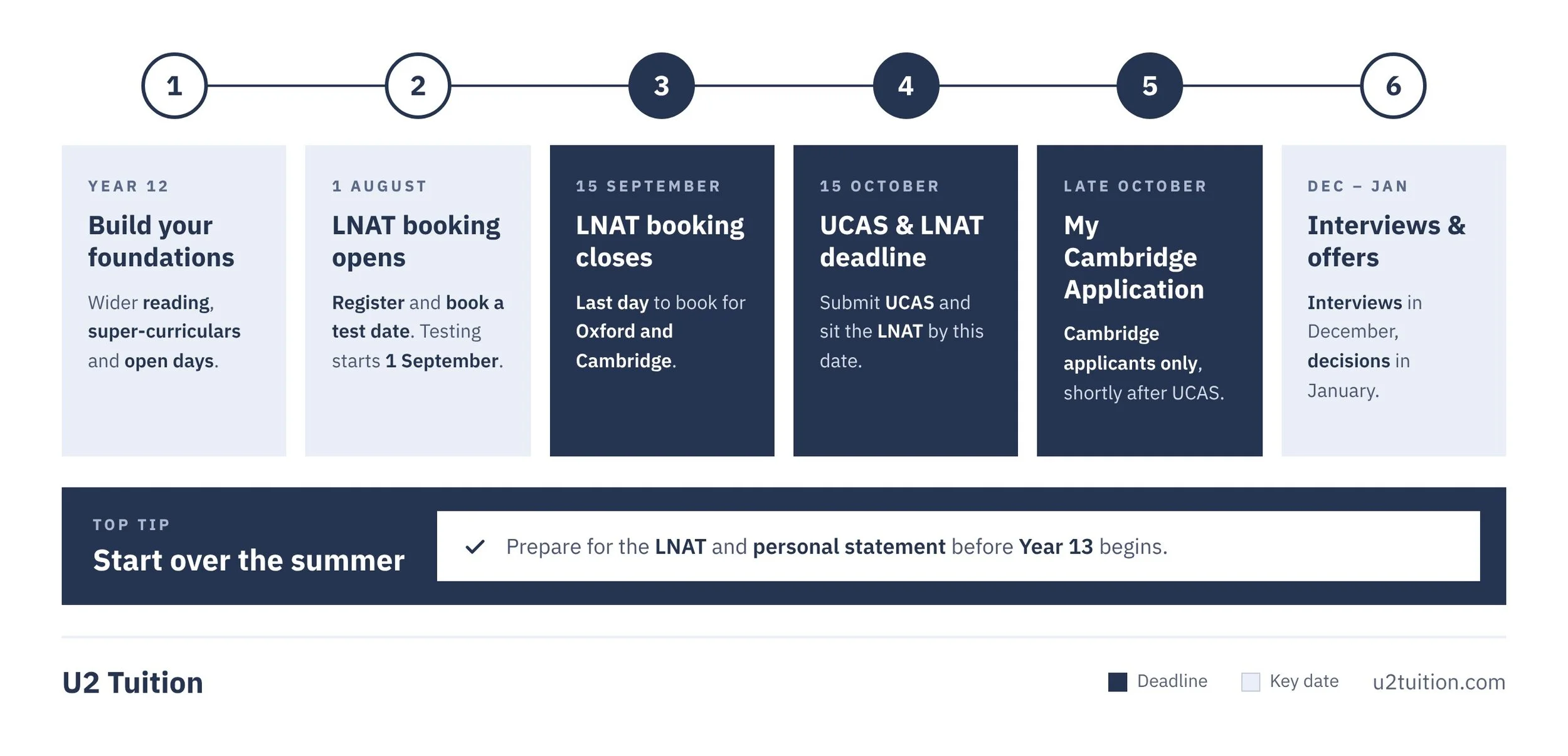
Oxbridge Law deadlines fall much earlier than those for most other UK universities. Your application is due on 15 October, around three months before the main UCAS deadline, and you must have sat the LNAT by the same date.
Cambridge applicants also have one extra step, the My Cambridge Application form, shortly after the UCAS deadline.
How U2 Tuition Supports Oxbridge Law Applicants
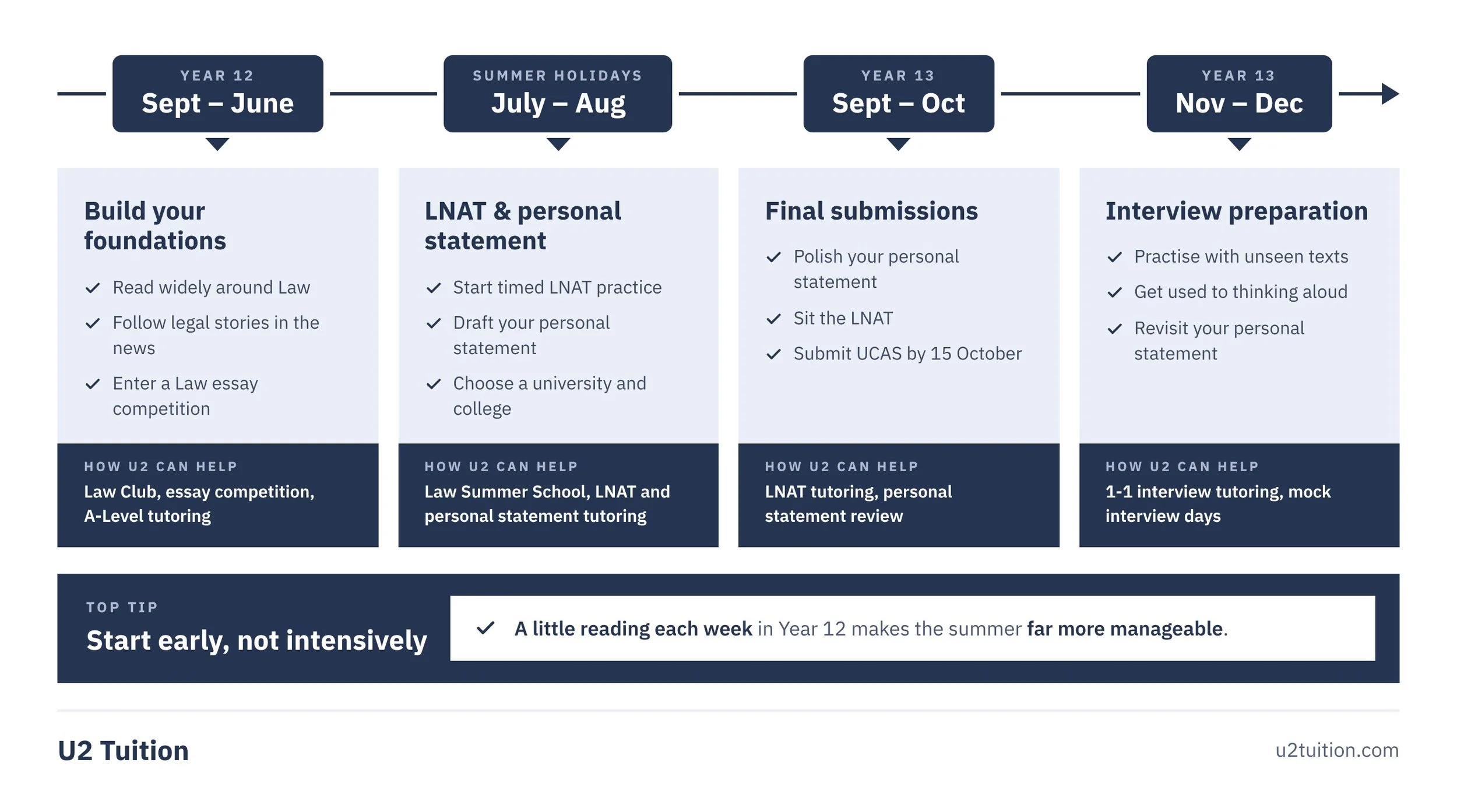
U2 Tuition supports Oxbridge Law applicants at every stage of the process. Our Law tutors studied at Oxford or Cambridge themselves, and support can be arranged as a full programme or as individual sessions focused on the areas where you need it most.
Choosing Between Oxford or Cambridge, and Picking a College
Oxford and Cambridge both offer outstanding Law degrees, but the courses differ in structure, teaching and entry requirements. Cambridge offers a single Law course with a typical offer of A*AA. Oxford offers Law (Course I) and Law with Law Studied in Europe (Course II), with a typical offer of AAA, and most Course II options require a relevant language. You will also need to choose a college or make an open application.
Our tutors can talk you through the differences between the two courses, help you decide which suits your interests and strengths, and help you compare colleges on the factors that matter, such as size, location and how many Law students they take each year.
Top tip: Compare the papers you would actually study at each university, not just their reputation. The course you will enjoy for three years is usually the one you will write about and discuss most convincingly.
LNAT Preparation
Both Oxford and Cambridge require Law applicants to sit the LNAT. Section A tests reading comprehension and reasoning through 42 multiple-choice questions, and Section B asks you to write an argumentative essay. Because Oxbridge applicants sit the test earlier than applicants to most other universities, there is less time to prepare.
Our LNAT tutoring focuses on the reasoning behind each question type rather than memorising tricks. Tutors work through timed practice with you, identify where you are losing marks and help you plan clear, well-structured essays under exam conditions.
Top tip: Do not treat the essay as an afterthought. Admissions tutors can read it alongside the rest of your application, so a focused, balanced argument matters as much as your Section A score.
Personal Statement Support
The personal statement is one of the few parts of your application that you fully control. For Oxbridge Law, admissions tutors want evidence of genuine academic interest: what you have read, the questions it raised and how you have thought about them.
Our tutors give detailed feedback across several drafts. Rather than writing your statement for you, they help you pick out your strongest ideas, show your thinking rather than list activities, and make sure every sentence earns its place.
Top tip: Only include what you are happy to discuss in depth. Interviewers often ask about books or ideas mentioned in your personal statement.
Oxbridge Law Interview Preparation
Oxbridge Law interviews test how you think, not how much law you know. You may be asked to analyse an unseen text, work through a legal problem or defend your view on a hypothetical scenario while the interviewer challenges your reasoning.
1-1 interview tutoring helps you become comfortable thinking aloud, structuring an argument and responding calmly to difficult follow-up questions. Sessions are tailored to your application and the university you are applying to.
Mock interview days recreate the experience of a real Oxbridge Law interview, with unseen material and interviewers who studied Law at Oxford or Cambridge. Each student receives detailed feedback on their reasoning and how they communicate it.
Wondering what to expect in your Oxbridge Law interviews?
Interviews can feel overwhelming due to their unpredictability, but they’re crucial, with some candidates excelling based purely on interview performance. This essential guide, created by U2’s Law tutors—Oxford and Cambridge Law graduates—will help you prepare, stand out, and increase your chances of success. It covers how to present yourself and communicate effectively during interviews.
Key components of U2 Tuition's Law guide:
- How to build evidence of subject exploration to demonstrate your passion. Our Law graduates guide you on what to read, including primary and secondary material, and how to cite key texts or online resources (e.g., podcasts) to support your reasoning during interviews. Each recommendation includes a thinking task—a related interview question. Start this process months in advance so you have lots of time to explore all these resources!
- Help preparing for qualitative questions, such as those based on your personal statement.
- Guidance for questions on current legal affairs, work experience, and legal careers.
- Guidance for preparing for ethical and moral dilemma questions.
- Advice for answering questions requiring statutory interpretation.
- Insights on what to expect in academic interviews, with detailed accounts from successful candidates. These accounts include the specific questions they were asked and tips for preparing for different interview formats.
- Worked-through interview questions, with clues and further reading suggestions on each topic.
- 40 additional past interview questions.
- Final tips for interview success.
Looking for Oxbridge Law mentoring to guide your independent preparation?
Having a Law mentor can be invaluable. U2 offers a network of Law undergraduates, graduates, and postgraduates who can provide tutorial sessions covering key topics, personal statement support, admissions test preparation, and interview practice. We also offer mock interview days in November/December. Learn more here.
Find out more about the Oxbridge tutoring and admissions support we offer here. Book a free consultation for further details on our offerings and to discuss your Oxbridge Law application.
A-Level and IB Tutoring
Strong grades are essential for an Oxbridge Law application. Your GCSEs and predicted grades help decide whether you are shortlisted for interview, and any offer will depend on achieving your final results. Neither university requires specific A-Level subjects for Law, but essay-based subjects can help develop the reading, writing and argument skills the course demands.

U2 Tuition offers one-to-one A-Level and IB tutoring across a wide range of subjects, helping students strengthen their understanding, improve exam technique and stay on track during a busy application year.
Building a Standout Academic Profile for Law Applications
A standout Oxbridge Law application shows that you have explored the subject beyond the classroom. Super-curricular activities such as summer schools, essay competitions and independent research matter far more to Oxbridge admissions tutors than extracurriculars like sport or music, because they show how you engage with academic ideas.
Through Minds Underground, the super-curricular division of U2 Tuition, students can take part in Law programmes led by Oxford and Cambridge Law graduates. Each one gives you something real to write about in your personal statement and discuss at interview.
Law Summer School
The Minds Underground Law Summer School gives Year 12 students the chance to try university-level Law before they apply. It runs online over eight weeks in July and August, with weekly 1.5-hour seminars led by Law graduates from Oxford and Cambridge. Topics range from squatters' rights and contract remedies to whether we still need jury trials or a Supreme Court.
Because sessions follow the format of an Oxbridge seminar, students also practise defending their reasoning under questioning, which is excellent preparation for interview. Classes are kept small, and recordings are available for any session you miss.
Law Essay Competition
The Minds Underground Law Essay Competition asks students to answer a university-style legal question in around 1,000 to 1,500 words. Entries are judged by Oxbridge-educated and industry experts on originality, quality of argument and evidence of wider reading, and winning essays are published as model essays. The competition is open to students worldwide, with the Senior category aimed at Year 12. Writing a competition essay is also excellent practice for the LNAT essay and for the extended writing you will do as a Law undergraduate.
The 2027 questions are released on 26 November 2026, and the deadline is 3 April.
Law Research Projects
A one-to-one guided research project lets you investigate a legal question in depth with an expert mentor. Projects usually run over four to five weeks, with a weekly one-hour tutorial and guided independent research between sessions. Areas include human rights, privacy and intellectual property, and criminal law. You finish with a completed piece of work and a strong talking point for interviews and personal statements.
For example, one project, hosted by a criminal pupil barrister and consultant at the Sentencing Academy, explores how sentencing is justified.
Law Club
The Minds Underground Law Club meets online every Saturday from 10 to 11am during the school year, hosted by Oxbridge Law graduates. Students discuss recent legal developments and prepare for personal statements, admissions tests and interviews alongside other aspiring Law applicants.
When Should You Start Preparing for Oxbridge Law?
Most successful Oxbridge Law applicants start preparing in Year 12, around a year before the UCAS deadline. This does not mean hours of extra work every week. Starting early gives you time to build a genuine interest in Law at a steady pace, so that by the summer before Year 13 you have plenty to draw on for the LNAT, your personal statement and interview. Starting later is still possible, but it leaves much less time to develop ideas of your own.
Looking Beyond Your Law Degree
An Oxbridge Law degree opens many doors, but for students hoping to become solicitors, the next set of applications starts sooner than many expect. Many law firms run first-year insight schemes, and most Law students apply for vacation schemes in their second year. These short placements are often the main route to a training contract, so a strong application early in your degree can shape your career long before you graduate.
U2 Tuition supports Law students at every stage. Our tutors, many of whom have trained at leading firms themselves, help students write focused applications, prepare for the Watson Glaser, practise video and partner interviews, and approach assessment centre tasks with confidence.
Oxbridge Law Application FAQs
When should I start preparing for an Oxbridge Law application?
Most applicants benefit from starting in Year 12, around a year before the UCAS deadline. This gives you time to read widely, take part in super-curricular activities and build genuine interest in Law at a steady pace. The summer before Year 13 is usually when LNAT and personal statement preparation become the main focus.
Do I need to study A-Level Law to apply to Oxbridge?
No. Neither Oxford nor Cambridge requires A-Level Law, and studying it does not give you an advantage. Admissions tutors are more interested in strong grades and the skills Law demands, such as close reading, clear writing and careful argument, which subjects like History, English and languages also develop.
Is the LNAT required for both Oxford and Cambridge?
Yes. Both Oxford and Cambridge require Law applicants to sit the LNAT, and Oxbridge applicants must sit it by the mid-October deadline, earlier than most other universities. The LNAT is booked separately from your UCAS application, so it is important to register in good time.
Can I apply to both Oxford and Cambridge for Law?
No. You can apply to either Oxford or Cambridge in the same application cycle, but not both. It is worth comparing the two courses carefully before deciding, as they differ in structure, teaching and entry requirements.
What do Oxbridge Law interviewers look for?
Interviewers are looking for potential, not legal knowledge. They want to see how you analyse unfamiliar material, build a logical argument and respond when your reasoning is challenged. Being willing to think aloud and refine your view in response to a good point is often more impressive than giving a polished answer.
Does U2 Tuition offer online Oxbridge Law tutoring?
Yes. U2 Tuition offers online tutoring for every stage of the Oxbridge Law application, including LNAT preparation, personal statement support and interview practice, with tutors who studied Law at Oxford or Cambridge. Minds Underground's Law Summer School, Law Club and research projects also run online, so students can take part wherever they are based.