

Westminster Cathedral Choir School (WCCS) 8+ Exam: Everything You Need To Know
Contents:
What is the 8+ Exam?
First things first, it’s very important to know exactly what the the 8+ exam is and what to expect. The 8+ entrance assessment is used by independent schools in the UK for children in Year 3, who want to gain a place in Year 4 the following year. Unlike the more common 7+ entrance point, the 8+ is designed to be much more rigorous, assessing academic strengths, reasoning skills and readiness for a more challenging curriculum. 8+ exams usually include papers in Maths, English and Reasoning, alongside a one-to-one interview with a senior staff member.
For Westminster Cathedral Choir School (WCCS) specifically, the 8+ exam has a slightly different selection process, depending on whether boys are applying for a day place or chorister place. WCCS do not usually include reasoning as part of their 8+ examination, however they maintain a strong focus on English (Comprehension, Composition, Punctuation and Spelling) and Mathematics. Parents register in Year 3, with assessments typically held in the January prior to entry.
For families who are interested in structured support, experienced 8+ specialists can make preparation far more focused and efficient. At U2 Tuition, we provide tailored 8+ preparation designed to strengthen core Maths and English skills while building exam confidence gradually. Our approach combines targeted skill development, exam technique, and realistic mock practice - helping children feel calm, capable and fully prepared on the day.
About Westminster Cathedral Choir School
Westminster Cathedral Choir School is a Catholic independent preparatory day and boarding school for boys aged 4–13 in London. It is closely linked with Westminster Cathedral and most famous for educating boys who sing in the choir of Westminster Cathedral, one of the world’s leading Catholic cathedral choirs. In their final year, boys are prepared for 13+ Common Entrance examinations and often go on to top UK secondary schools.
WCCS has around 270 boys in total, with around 250 being day boy students and approximately 20 being boarding choristers. Choristers are typically admitted starting in Year 4 (age 8) and receive specialised musical training alongside regular schooling. The entry process for both day boys and choristers is incredibly competitive and rigorous, so prior preparation is highly encouraged.
WCCS 8+ Timeline & Admissions Process (Day Boy Places)
Day boys are pupils who attend school during the day and go home in the evenings (they don’t board Monday - Friday as choristers do). This is the most common route for most boys at the school.
Day boys benefit from the same excellent academic education and extracurricular opportunities but do not have to sing in the Cathedral Choir (unless they choose to pursue music outside the formal choir programme).
Unlike chorister entry, day boys do not need to audition musically to be admitted. Instead, the admissions process for Day Boy Places is as follows;
Register in Early December (Year 3) - Parents must register boys and pay the registration fee by the deadline listed on the WCCS website - this is usually in the year prior to entry
(e.g. The 7+/8+ registration deadline for 2027 places was 1st December 2026).
Assessment Day in January - Pupils sit written papers in English and Maths alongside taking part in activities.
Results & Offers - WCCS typically notifies families a few weeks later, with acceptance paperwork and deposits due by the school’s deadline.
WCCS 8+ Timeline & Admissions Process (Chorister Places)
Admissions for Chorister places at WCCS work slightly differently to those for day students, with the approach taking a less strictly academic and more talent-based approach. Accepted choristers begin in September of Year 4 as probationers, learning the choir’s repertoire and techniques. Every September, around 5–6 new choristers join in Year 4 (some may join in Year 5 where spaces allow).
The application process for Chorister places is as follows;
Initial Interest and Zoom Q&A - These are usually held every half term and give prospective families a chance to learn about chorister life and expectations.
Informal meetings & visits - Prospective families are invited in to speak with the Master of Music and music staff to get a feel for the school environment.
The boys have a chance to sing one of the songs they’ve learned - this isn’t judged formally but helps both sides see if it might be a good fit.
Formal audition date(s) - Auditions happen throughout the year, often in the year before entry.
The school provides sample songs and backing tracks so boys can practise at home ahead of any audition.
Singing - a short audition where the boy shows how he sings and interacts with music.
Academic assessments in English and Maths - similar process to the day boy examinations.
Optional instrument performance - boys can play a piece if they already play an instrument, though this isn’t required.
Offers issued - After auditions and assessments, boys may receive offers that families can accept or decline.
Unlike for day boy places, there are no registration fees for Chorister places. Choristers can often receive generous musical scholarships, usually covering a large proportion of fees, plus means-tested bursaries up to 100% to support families.
Interested in applying to Westminster Cathedral Choir School but not sure where to start? Our expert team are here to provide you with the support you need when going through the admissions process.
Start your child’s path to success…

WCCS 8+ Exam Format & Subject Breakdown
English (Comprehension & Composition)
There are three separate English papers in the 8+ WCCS entrance examination. The first focuses on comprehension and creative writing, while the second and third assess spelling, punctuation and grammar. The comprehension and composition paper typically lasts around 1 hour and 10 minutes: 50 minutes for the comprehension section and 20 minutes for creative writing.
In the comprehension task, boys are usually given an extract from a story and asked a range of questions based on both text, subtext and language devices. These questions assess a pupil’s ability to retrieve information, make inferences and understand the deeper meaning behind what is written.
Importantly, pupils are also tested on their knowledge of language devices such as similes, metaphors, personification and onomatopoeia. Achieving high marks requires more than simply spotting these techniques. The key is being able to explain clearly WHY the author has used them and HOW they affect the reader.
In the second part of the assessment, boys will write their own short story inspired by a picture prompt (although it is good to practice creative writing using both written and visual prompts).
This task allows them to demonstrate creativity, imagination and technical accuracy. To achieve high marks in this section, boys should:
Use accurate punctuation and spelling
Structure their writing clearly with paragraphs
Choose interesting and varied vocabulary
Develop their ideas clearly and effectively
Demonstrate a clear ability to use language devices in their work (similes, metaphors, alliteration etc…)
WCCS provide example papers for all elements of their 8+ examination. You can access example papers from 2025 below;
WCCS Comprehension and Composition Paper 1 - HERE
WCCS Comprehension and Composition Paper 2 - HERE
English (Spelling, Punctuation & Grammar)
For these sections of the WCCS examination, boys are asked to take two separate papers. The first is around 30mins long and focusses on punctuation, whereas the second (around 15mins in length) assesses the boy’s spelling ability.
For the first paper, boys are usually asked to rewrite an unpunctuated passage of text. Boys are expected to be confident in using full stops, capital letters, commas, apostrophes, question marks and exclamation marks.
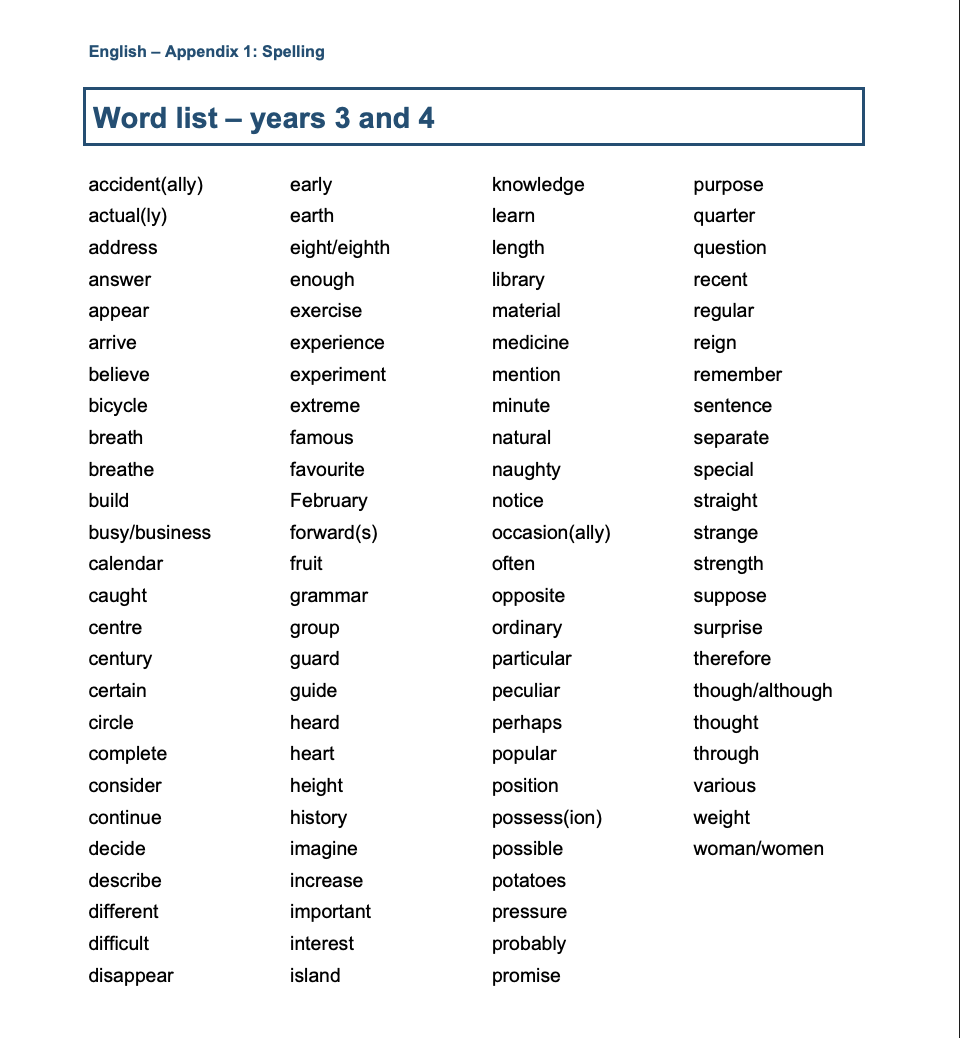
For the second paper, boys are asked to rewrite up to ten given sentences, correcting any spelling mistakes as they go. Boys are expected to know at least the core Key Stage Two English Spelling List for Years 3 & 4, but are sometimes tested on more challenging spellings too.
The Government Issued National Curriculum Key Stage Two English Spelling List for Years 3&4 can be seen below;
Mathematics

The Mathematics element of the WCCS 8+ paper involves a 45min paper covering expected subject knowledge of the National Curriculum for Year 3-4 Mathematics.
Boys should be familiar and confident with the following concepts at a Year 3-4 ability level;
NUMBER - Place value, Counting, Addition, Subtraction, Multiplication, Division, Sequences, Fractions, Money
SHAPE, SPACE AND MEASURE - Scales / Estimation / Rounding, Measurements, Time, Co-ordinates, Angles, Direction, 2D/3D Shapes, Line Symmetry
DATA HANDLING - Carroll & Venn diagrams, Presenting Data
Further details about specific mathematical knowledge for 8+ entry can be found HERE.
Example WCCS 8+ Maths papers can be found HERE and HERE.
For Further Academic Guidance, Contact U2 Tuition or visit our 8+ Tuition Page today.

How to Prepare for the WCCS 8+ Exam
Although WCCS note that no prior preparation is necessary, it’s always a good idea to plan ahead to ensure boys are feeling confident and comfortable on the day. The good news? At 8+, preparation doesn’t need to be intense or overwhelming. With the right approach, you can build skills and confidence, without pressure!
Below are the things you should think about when preparing for WCCS 8+ at home;
Understand the key elements of the 8+ examination and practice core skills accordingly:
English
Reading - practice reading a wide range of texts, including fiction and non-fiction.
Comprehension - practice building inference skills using the age appropriate texts (such as those provided above and those at school).
Ensure your child is familiar with language devices such as similes, metaphors, onomatopoeia, personification and alliteration.
Encourage your child to discuss characters, events and intention alongside why the author has used specific language devices such as similes, metaphors and alliteration.
TOP TIP: Always think about WHY the author has chosen to do something and HOW it affects the reader.
Creative Writing - Practice writing using written AND visual prompts.
Continuing a story, keeping a diary or even short bursts of setting description can be really great ways to encourage creative output.
Maths - make sure your child is comfortable with the core areas of the National Curriculum for Year 3-4 Mathematics.
Online practice papers (which are easily found online) are a great way to gauge your child’s ability and identify areas that need improvement.
Performance (for chorister boys only) - the chorister exam is designed to identify musical potential, not polished performance. Most boys applying will not have had extensive formal training - and that’s completely fine.
Instead ensure:
Your child is comfortable performing in front of an audience, even if it just one or two people.
Practice good singing posture and breathing technique
Practice aural ability at home (e.g. note matching, clapping rhythms, sight singing etc…)
Build a Simple Weekly Routine
Children preparing for 8+ don’t need hours of study. Consistency beats intensity. A realistic structure might be:
2–3 short sessions per week (30–40 minutes)
One maths-focused session
One English-focused session
One mixed session (or a second session of English / Maths depending on which is the weaker area)
Practise Time Awareness
Try building familiarity without creating stress. At home practice could gently introduce:
Short timed comprehension tasks
15–20 minute writing tasks
Quick mental maths drills
How can U2 Tuition Help?

When it comes to preparing for the WCCS 8+ exam, targeted support makes all the difference. At U2 Tuition, our expert 8+ tutors are specialists in competitive London independent school entry, including Westminster Cathedral Choir School.
Our tutors focus on:
Preparation for all test components
Advanced 8+ problem solving skills
English comprehension techniques
Creative writing structure and vocabulary development
Exam confidence and time management
Practice paper familiarity
Building interview confidence
If you’re seeking structured, results-driven WCCS 8+ tuition in London or online, U2 Tuition offers specialist support tailored to competitive school entry.
Visit our 8+ Tuition Programme page for more information, check out our Mentors Page or…
Related blogs and other U2 Tuition Resources:
11+ Recommended Reading Blog (contains reading lists for Years 3-4)
