

Mastering 11 Plus Verbal Reasoning: A Complete Guide for Parents and Students
Contents:
Preparing for the 11+ Verbal Reasoning exam can feel like a long and challenging journey for both parents and students. Unlike 11+ Maths or 11+ English Comprehension, 11+ Verbal Reasoning tests a child’s ability to think critically with words, recognise letter and word patterns alongside solving problems logically under strict time pressure.
The good news? 11+ Verbal Reasoning improves significantly with structured and consistent practice. As children become familiar with common 11+ verbal reasoning question types, their speed, accuracy and confidence increase. The key to success in the 11+ Verbal Reasoning exam is recognising the rule or pattern behind each question. Once a child understands the core structures and common themes, they can approach even the most challenging problems with confidence.
In this guide, we’ll explain exactly what 11+ Verbal Reasoning involves, why it plays such a crucial role in securing a school place. Take a look at U2 Tuition’s 11+ expert tutors, who can help your child build the skills, speed and exam technique needed for success.
Contact us today to find out more about how we can help your child succeed in the 11+ examinations.
What is 11+ Verbal Reasoning? Which Schools Test It?
Verbal Reasoning is a major component of the 11+ exam, with many Grammar Schools and Independent Schools, especially in London, setting a dedicated Verbal Reasoning paper as part of their entrance assessments. 11+ Verbal Reasoning questions assess vocabulary, comprehension, sequencing skills and logical reasoning using written language.
Verbal reasoning skills are tested by most major schools as part of their entry exams, but it is important to check which 11 Plus exam board is used for the specific school(s) in question as the approach can differ slightly.
Some common boards testing Reasoning include;
GL Assessment - (Granada Learning)
4 written papers —> English, Maths, Verbal Reasoning and Non-Verbal Reasoning.
Example schools: Henrietta Barnett, Dame Alice Owens and Tonbridge Grammar.
ISEB Common Pre-Test - (Independent Schools Exam Board)
Online —> English, Mathematics, Verbal Reasoning, and Non-Verbal Reasoning.
Example schools: St Pauls, Westminster, Lady Eleanor Holles School and Charterhouse.
CEM / CEM Select - (The Centre for Evaluation and Monitoring / Cambridge Select Insight)
2 written papers —> English Skills and Verbal Reasoning and Maths and Non-Verbal Reasoning Skills
Example schools: St Pauls Girls, City of London Girls, Haberdashers' Boys' School, Eton and Harrow.
CAT4 - (Cognitive Abilities Test)
Online —> Verbal Reasoning, Non-Verbal Reasoning , Spatial Reasoning and Quantitive Reasoning.
Example: Wycombe Abbey, Christ’s Hospital and North London Grammar School.
QUEST - (produced by Atom Learning)
Online —> English, Maths, Verbal Reasoning, Non-Verbal Reasoning, Creative Comprehension and Puzzles & Problem Solving.
Example schools: Cheltenham Ladies' College, Dulwich College, Godolphin & Latymer School, Francis Holland School and Channing.
Not sure which school(s) to target? Check out our blog on Top UK Grammar Schools HERE.
⬇️ Unsure which exam board you're looking for? ⬇️
Which Verbal Reasoning Types Appear In The 11+ Exam?
Broadly speaking, there are around 21 different question types that students should prepare for in the 11+ exam, although this can vary slightly depending on the specific schools being applied to. It’s important to remember that not every question type will necessarily appear in the test. However, thorough preparation across all question types is essential to avoid being caught off guard on the day of the exam.
Vocabulary Based Questions
These test vocabulary and word knowledge alongside understanding of meaning. Although they may seem straightforward, these questions often include subtle distractors designed to catch out those who rely on guessing rather than true understanding.
Includes:
Synonyms
Antonyms
Word meanings
Cloze (missing word) questions
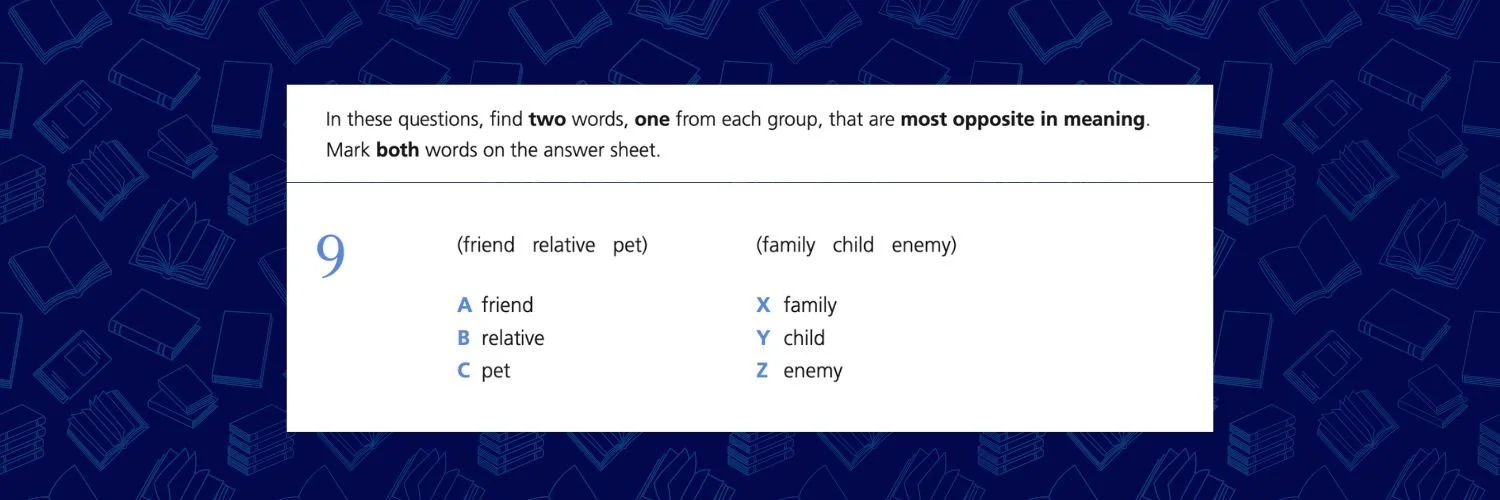
An example question for a Vocabulary Based Question might be;
-
The answer is: A and Z
The two words, one from each group, that are most opposite in meaning are ‘friend’ from group one and ‘enemy’ from group two.
Word Structure & Formation Questions
These questions test a child’s understanding of how words are built, connected and transformed. Pupils must recognise prefixes, suffixes, compound words, hidden words and anagrams, demonstrating flexibility in how they manipulate language. Although they can appear mechanical at first glance, word structure and formation questions often require careful attention to detail, as small changes in spelling or letter order can completely alter meaning.
Includes:
Compound words
Prefixes and suffixes
Hidden words
Anagrams
Word pair relationships
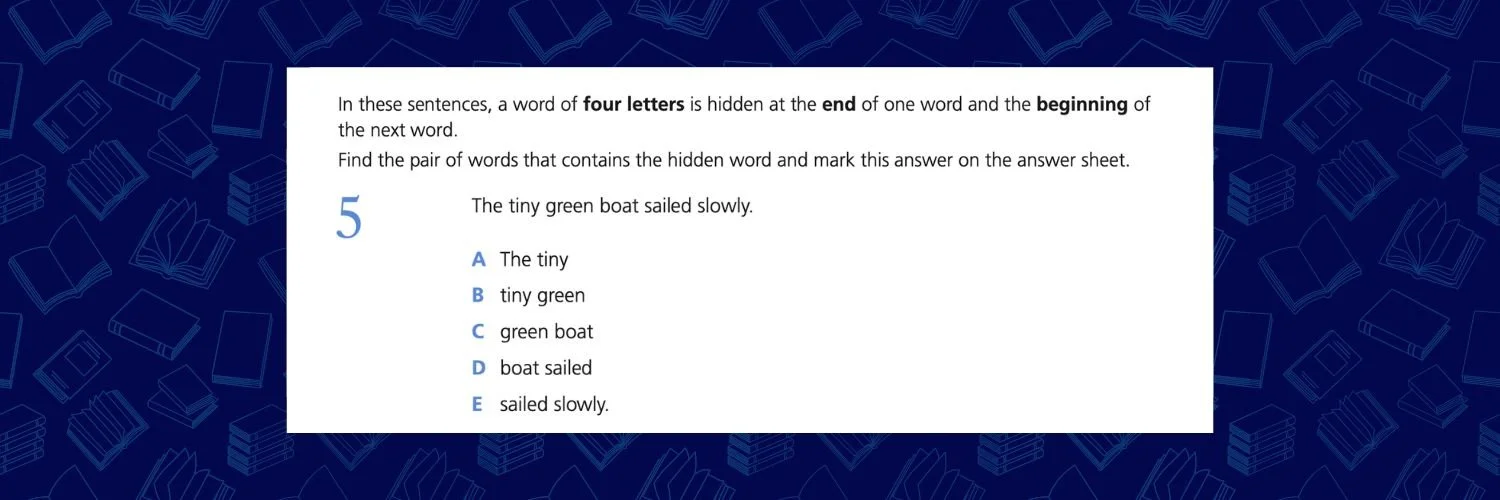
An example question for a Word Structure and Formation Question might be;
-
The answer is: C
In this sentence, the hidden four-letter word is ‘oats’, which is made up of the last three letters of the word ‘boat’ and the first letter of the word ‘sailed’. So the pair of words that contains the hidden word is ‘boat sailed’.
Letter & Number Pattern Questions
These questions test a child’s ability to recognise patterns and apply logical rules using letters and numbers. Pupils may need to identify sequences, decode letter–number relationships, or use alphabet positions (A=1, B=2) to solve problems. While they can seem repetitive, these questions often contain layered patterns or shifts in sequence designed to challenge pupils who look only at the surface pattern rather than analysing the rule carefully.
Includes:
Letter sequences
Number-letter codes
Alphabet position questions (A=1, B=2)
Coding and decoding
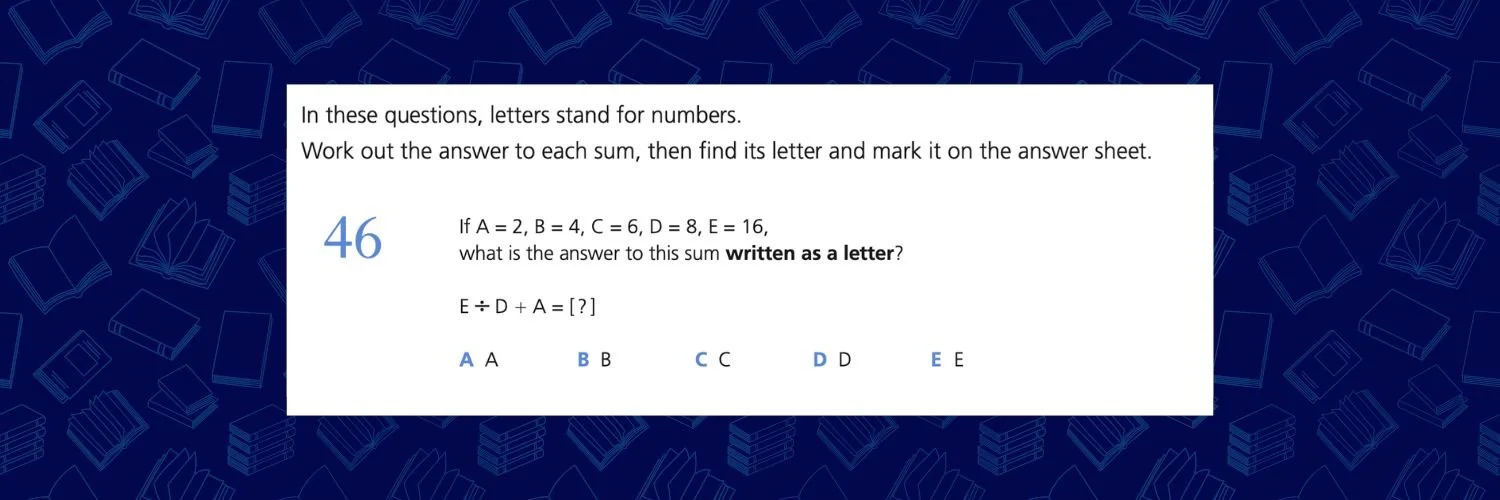
An example question for a Letter and Number Pattern Question might be;
-
The answer is B.
In this question, A = 2, B = 4, C = 6, D = 8, E = 16. If we convert the letters into numbers, the answer to the sum is 4. We can see that B = 4, therefore, the answer to this sum written as a letter is B.
Logical Deducation & Reasoning Questions
These questions test a child’s ability to think analytically, interpret clues and apply logical reasoning to reach a clear conclusion. Pupils must carefully read short statements, eliminate impossible options and piece together information methodically. Logical deduction questions are designed to reward precise, ‘outside-the-box’ thinking and attention to detail.
Includes:
Logic puzzles
Statement-based reasoning
Word-based problem solving
Finding the odd one out
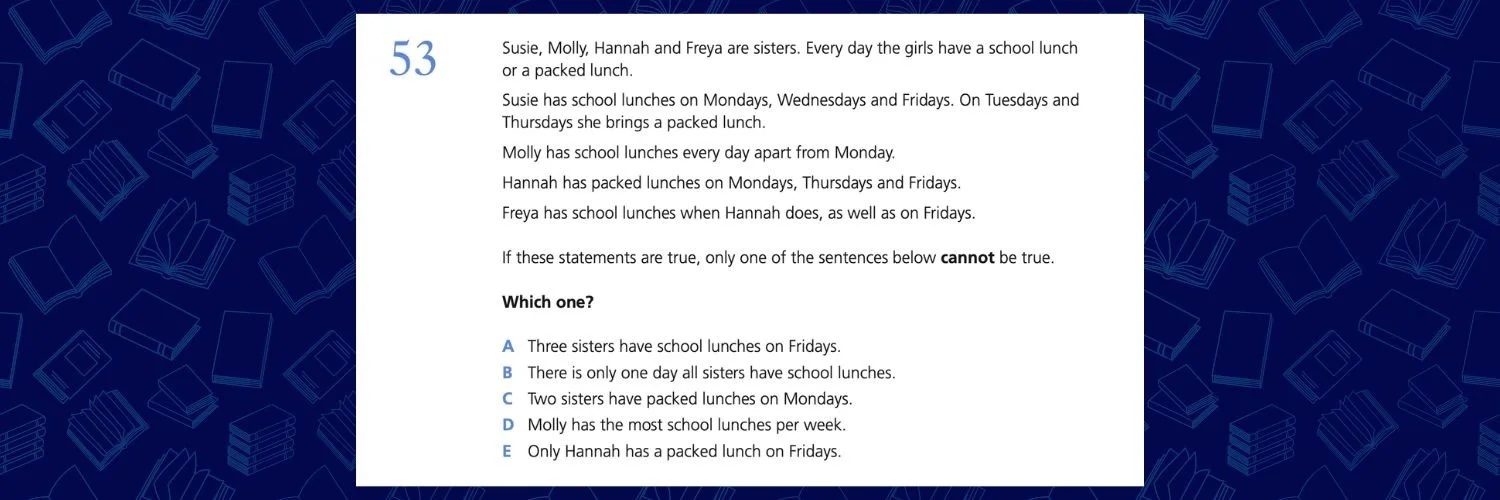
An example question for a Logical Deduction and Reasoning Question might be;
-
The answer is C.
To find the answer to this question we must first work out each sister’s lunches.
Susie has school lunches on Monday, Wednesday and Friday.
Molly has school lunches every day except Monday.
Hannah has packed lunches on Monday, Thursday and Friday, so she has school lunch on Tuesday and Wednesday.
Freya has school lunches when Hannah does (Tuesday and Wednesday) and also on Friday.
Now look at Monday.
On Monday, Susie has school lunch but Molly, Hannah and Freya all have packed lunches. That means three sisters have packed lunches on Monday.Option C says two sisters have packed lunches on Mondays. This is not possible.
All the other statements match the information given.
So the answer is C.

Need further support with Verbal Reasoning?
We have a highly experienced team of 11+ tutors who specialise in 11+ Verbal Reasoning and understand the techniques needed to succeed. Having completed the 11+ themselves and attended leading grammar and independent schools, our tutors know exactly what examiners are looking for.
If you’re seeking expert 11+ Verbal Reasoning tuition, we’ll match your child with a tutor who has experience and success with your target school(s), ensuring focused and relevant preparation.
With the right guidance, verbal reasoning becomes far less intimidating. Our sessions break down common question types, build vocabulary and sharpen exam technique, allowing students to improve speed, accuracy and confidence ahead of their 11+ exam.

Tips and Tricks for Tackling Verbal Reasoning Questions
While regular preparation is essential, there are several techniques you can practice at home that can make tackling these questions a little bit more manageable.
Understand Key Question Types & Concepts
As shown above, Verbal reasoning questions usually fall into various categories. Being familiar with the different types of question helps students apply the right strategy quickly.
Make sure your child is familiar with concepts such as;
Synonyms / Antonyms —> similar / opposite meanings
Analogies —> word relationships
Alphabet and Letter Patterns —> recognising sequences or shifts in letters
Prefixes and Suffixes —> found at the start / end of a word and often change its meaning
Root Words —> e.g. ‘Bio’ = ‘life’ —> biography, biology, biodiversity
Homophones and Homonyms —> Words that have multiple meanings / sound the same but have different meanings or spellings
Word Forms —> adjectives, nouns, adverbs, verbs
Expand Vocabulary
A rich vocabulary is one of the biggest advantages in verbal reasoning. Make sure your child is regularly reading age-appropriate books, newspapers or online articles and make a habit of noting new words and their meanings. Flashcards or apps can help reinforce this knowledge.
💡 Top Tip: Keep a “Vocabulary Notebook” to jot down unfamiliar words. Then look them up and write definitions / practice using them in a sentence. Over time, this builds a personal reference guide that continues to strengthen and challenge vocabulary.
Look for Clues
Many verbal reasoning questions have subtle hints:
Prefixes like ‘un-’ or ‘dis-’ indicate opposites.
Suffixes like ‘-able’ or ‘-less’ can help you infer meanings.
Word roots from Latin or Greek often appear in analogies.
Practice Mental Shortcuts
Process of Elimination: Cross out answers that are clearly wrong to increase your odds of guessing correctly.
Spot patterns: For sequences, check for alphabetical order, letter shifts or repeated cycles.
Think in pairs: In analogies, identify the relationship (e.g. part to whole, cause and effect) before looking at answer choices.
Time Management
Even the brightest students can struggle if they spend too long on a single question. During timed practice, encourage students to move forward if they are spending too long on a question and come back to it later if time allows.
💡 REMEMBER: It is better to miss one tricky question than a whole page if they run out of time!
REGULAR PRACTICE!
This one cannot be stressed enough! Verbal reasoning is a skill that improves with practice and familiarity. Use past papers, online quizzes and worksheets to build confidence and speed. Review mistakes carefully and encourage your child to explain WHY they have made a specific choice. Understanding why an answer is wrong / right is more valuable than just getting the answer correct.
💡 Top Tip: A short, consistent routine (around 15–20 minutes of focused practice per day) is far more effective than long, infrequent sessions.
Get Expert Support from a U2 Tutor

At U2 Tuition, we provide focused guidance to help students develop essential skills in vocabulary, word relationships, analogies, sequences and logical thinking - key areas for excelling in verbal reasoning. Through a mix of practice questions, mock exams and interactive exercises, our tutors ensure that students approach verbal reasoning tasks with confidence and clarity.
We also offer comprehensive support across all other 11+ exam components - English, Maths and Non-Verbal Reasoning. Our tutors can tailor a personalised learning plan for each and every student, targeting strengths and areas for improvement, helping them build a well-rounded skillset across all exam papers.
Our 11+ Summer Courses in English and Maths are also an excellent way to supplement your child’s preparation. These intensive, engaging courses reinforce key concepts while keeping students motivated and on track during the summer break. Learn more about our 11+ Summer Courses here.
Looking for more information on other areas of the 11+ Exam? Check out our other 11+ blogs below ⬇️
Mastering 11+ Non Verbal Reasoning: Key Strategies for Success
Early 11+ Preparation: How To Build Confidence, Reasoning Skills and Exam Readiness
Mastering 11+ Reading Comprehension: Top Tips and Resources for Success
11+ Exam Recommended Reading: The Best Books & Resources to Build Strong Readers
Mastering 11+ Maths: Key Topics, Past Papers, & Parent Guide
