

CAT4 Test Guide: What Parents Need to Know and How to Prepare
If your child has been asked to sit the CAT4 (Cognitive Abilities Test), you may be wondering what it involves and whether they should prepare for it.
One of the biggest misconceptions about the CAT4 is that it cannot be prepared for because it tests reasoning rather than school knowledge. While it is true that the CAT4 is different from a traditional English or maths exam, familiarity with the question types and confidence under timed conditions can make a significant difference to a child’s performance.
At U2 Tuition, we help students across the UK and internationally prepare for CAT4 assessments used for 11+ & 13+ admissions, grammar school entry, independent school applications and school placement assessments.

Blog Contents:
What is the CAT4 Test?
The CAT4 (Cognitive Abilities Test Fourth Edition) is a nationally recognised assessment developed by GL Assessment, one of the UK's leading providers of educational testing.
Rather than assessing academic knowledge, the CAT4 measures a student's underlying cognitive abilities; the thinking skills they use when solving new problems, recognising patterns and processing information.
In other words, the CAT4 is designed to answer a different question from a traditional exam.
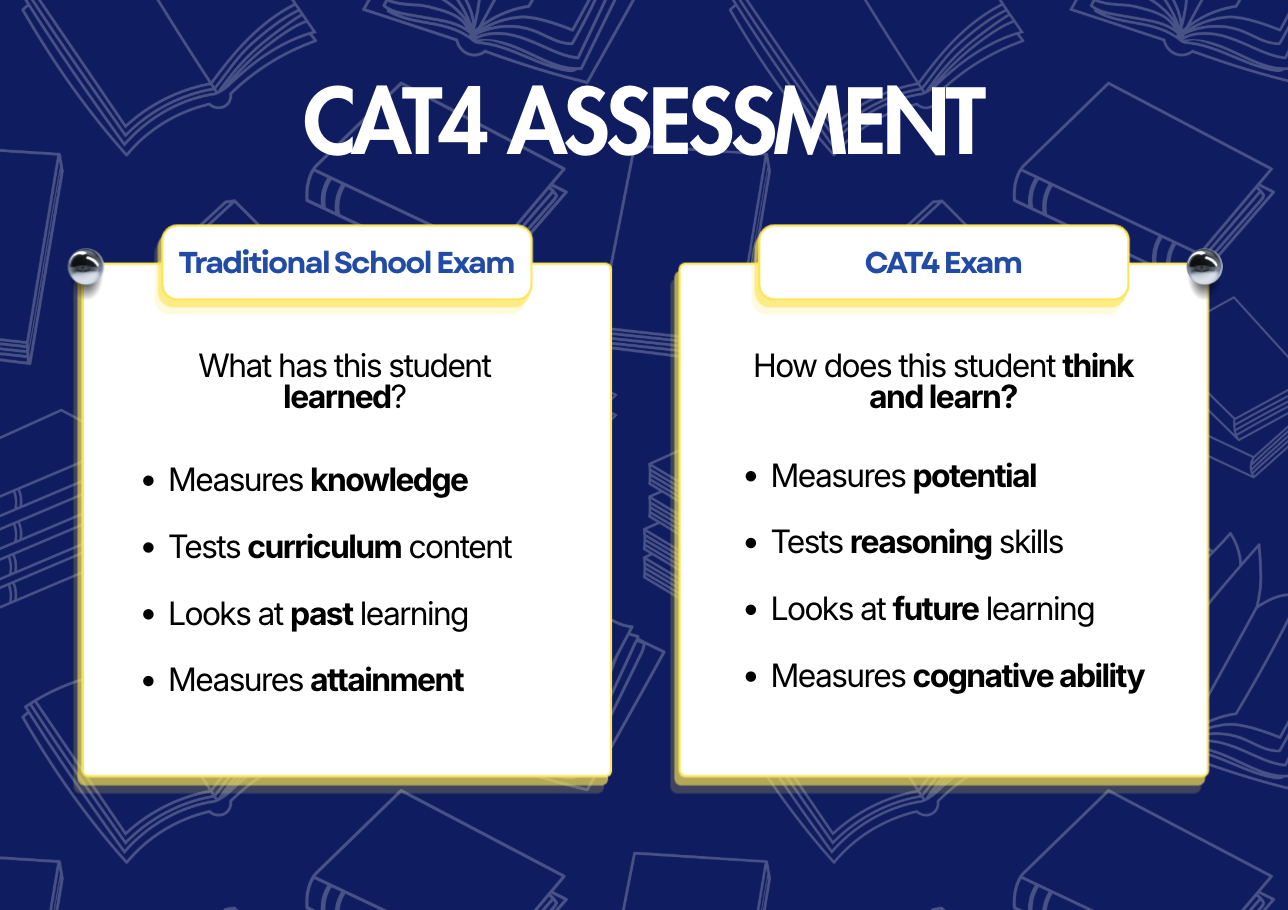
Image Copyright of U2 Tuition
This makes the CAT4 particularly valuable for schools, as it provides insight into a child's academic potential regardless of the curriculum they've previously studied.
For example, two students may have achieved similar grades in school, but one may demonstrate particularly strong spatial reasoning while another excels in verbal reasoning. These differences help teachers understand how each child is likely to learn most effectively and where their natural strengths lie.
What Does The CAT4 Exam Assess?
The assessment measures four key areas of reasoning:
Verbal Reasoning ➡️ thinking with words and language.
Quantitative Reasoning ➡️ solving problems using numbers and mathematical relationships.
Non-Verbal Reasoning ➡️ recognising visual patterns and logical relationships between shapes.
Spatial Reasoning ➡️ mentally manipulating and visualising objects in three-dimensional space.
Together, these four reasoning batteries provide a well-rounded picture of a student's cognitive profile.
Unlike many entrance assessments, the CAT4 does not have a simple pass or fail mark. Instead, students receive standardised scores that compare their performance with other children of the same age across the UK.
This makes the CAT4 an excellent tool for identifying both strengths and areas for development, rather than simply measuring how many questions were answered correctly.
Why Do Schools Use the CAT4?
So why do schools place so much importance on a test that doesn't assess the school curriculum?
The answer lies in what the CAT4 measures.
Academic tests such as English and maths exams show what a student already knows. The CAT4, however, looks at the reasoning skills that underpin learning itself. By understanding how a student processes information, schools can make more informed decisions about admissions, teaching and academic support.
Schools may use CAT4 results to:
support admissions decisions alongside interviews and entrance exams
identify students with strong academic potential
place pupils into appropriate teaching groups or sets
recognise gifted and talented learners
identify students who may benefit from additional support
predict future academic performance
help teachers tailor lessons to different learning styles
Many schools administer the CAT4 shortly after students join, particularly at the start of Year 7, to help staff build a detailed understanding of each child's learning profile from the outset.
For admissions teams, the CAT4 is particularly useful because it allows applicants from different educational backgrounds to be assessed using the same benchmark. Whether a child attends a state school, an independent school or is applying from overseas, the CAT4 provides schools with a consistent measure of cognitive ability.
Rather than replacing academic assessments, the CAT4 is usually considered alongside other information, such as school reports, interviews and entrance examinations, helping schools gain a more complete picture of each applicant.
Which Schools Use the CAT4?
The CAT4 is one of the most widely used cognitive assessments in the world and is administered in thousands of schools across the UK and internationally.
Different schools use the assessment in different ways, so it's important to check how your chosen school incorporates CAT4 into its admissions or assessment process.
Schools that commonly use CAT4 include:
Independent schools
Grammar schools
State schools
Academy trusts
British international schools
International schools following the English National Curriculum
Some schools include CAT4 as part of their admissions process alongside English and maths entrance papers, while others use it once students have enrolled to support teaching and learning. Because every school uses the assessment slightly differently, it's always worth checking the admissions information provided by your chosen school.
Can Students Sit the CAT4 at Any Age?
The CAT4 assessment is split between 10 levels, each with content specific to each age group:
Level A: Year 4 (ages 8–9)
Level B: Year 5 (ages 9–10)
Level C: Year 6 (ages 10–11) (11+ Entry)
Level D: Year 7 (ages 11–12) (11+ Entry)
Level E: Year 8 (ages 12–13) (13+ Entry)
Level F: Year 9 & 10 (ages 13–15) (14+ Entry)
Level G: Year 11 (ages 15+) (16+ Entry)
Looking for CAT4 Tuition for your child? Book a Free 20 min Consultation with one of our Expert Academic Advisors today for information on CAT4 Tuition for all levels!
What Skills Does the CAT4 Test?
As discussed above, the CAT4 isn't designed to test a student's knowledge of the school curriculum. Instead, it measures the reasoning skills that underpin successful learning across a wide range of subjects.
The assessment is divided into four reasoning batteries, with each one examining a different way of thinking. Together, these provide schools with a detailed picture of a student's cognitive strengths, helping teachers understand how they process information, solve problems and respond to new challenges.
Each battery contains two different question types and is made up entirely of multiple-choice questions. Rather than relying on memorised knowledge, students are presented with unfamiliar tasks that require them to recognise patterns, identify relationships and apply logical thinking.
Verbal Reasoning
Verbal Reasoning assesses how well a student thinks using words, language and written information. It focuses on recognising relationships between words and ideas, rather than testing spelling, grammar or vocabulary learned by rote.
Students with strong verbal reasoning skills are often able to identify patterns in language quickly, understand complex written information and draw logical conclusions from what they read.
The CAT4 assesses verbal reasoning through two question types:
Verbal Classification
Students are presented with three words that share a common characteristic or belong to the same category. They must identify the relationship between them and choose another word that best completes the group.
These questions assess a student's ability to identify concepts and categorise information using language.
Example Question:
Which word belongs with the group?
Apple, Banana, Orange
A) Carrot
B) Pear
C) Potato
D) Lettuce
E) Cucumber
-
Answer: B) Pear
Explanation: The first three words are all fruits. Pear is the only option that belongs in the same category.
Verbal Analogies
Verbal analogies test a student's ability to recognise relationships between pairs of words.
Questions follow the familiar format:
Example Question:
Dog : Puppy —> Horse : ?
A) Stallion
B) Cat
C) Foal
D) Hoof
E) Pony
-
Answer: C) Foal
Explanation: Puppy is the infant version of a Dog, so Foal follows the same pattern.
Quantitative Reasoning
Despite involving numbers, Quantitative Reasoning is not a traditional maths test.
Instead of testing curriculum knowledge such as fractions, algebra or geometry, this section measures how students reason with numbers and recognise mathematical relationships.
Students are expected to identify patterns, make logical connections and solve unfamiliar numerical problems.
This battery contains two question types.
Number Analogies
Students identify the rule connecting one pair of numbers before applying the same relationship to complete another pair.
Rather than carrying out lengthy calculations, success depends on recognising numerical patterns quickly and accurately.
Example Question:
6 : 12 —> 8 : ?
A) 12
B) 14
C) 16
D) 18
E) 20
-
Answer: C) 16
Explanation: The first number is doubled (6 × 2 = 12). Apply the same rule: 8 × 2 = 16.
Number Series
Students are presented with a sequence of numbers and asked to determine the next value in the pattern.
The sequences vary in complexity, encouraging students to think logically and identify relationships rather than relying on memorised mathematical methods.
Example Question:
4, 8, 12, 16, ?
A) 18
B) 20
C) 22
D) 24
E) 26
-
Answer: B) 20
Explanation: The numbers increase by 4 each time.
Non-Verbal Reasoning
The Non-Verbal Reasoning battery removes words and numbers almost entirely.
Instead, students solve problems using shapes, diagrams and visual patterns, making this section an excellent measure of abstract reasoning.
Because language plays very little role, non-verbal reasoning can provide a fair assessment for students from a wide range of educational and linguistic backgrounds.
Students must identify relationships between figures, recognise similarities and differences, and apply logical thinking to unfamiliar visual information.
This section includes two question types.
Figure Classification
Students examine a group of shapes or diagrams to identify the rule that links them together before selecting another figure that follows the same pattern.
These questions assess pattern recognition, logical thinking and visual analysis.
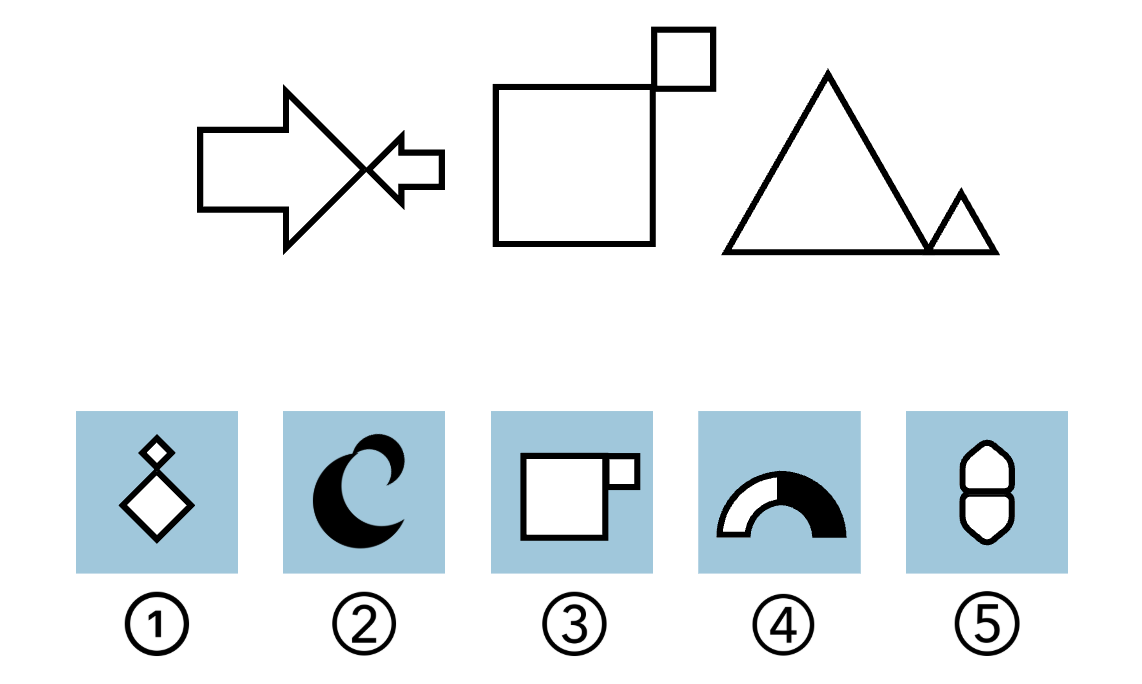
Image Copyright of U2 Tuition
-
Answer: 1
Explanation: The shapes are the same colour and consist of one larger and one smaller joined by a corner (not a flat face).
Figure Matrices
Figure matrices work in a similar way to verbal analogies but use images instead of words.
Students identify the relationship between one pair of figures before applying the same reasoning to complete a second visual sequence.
This requires careful observation and the ability to spot subtle visual changes.
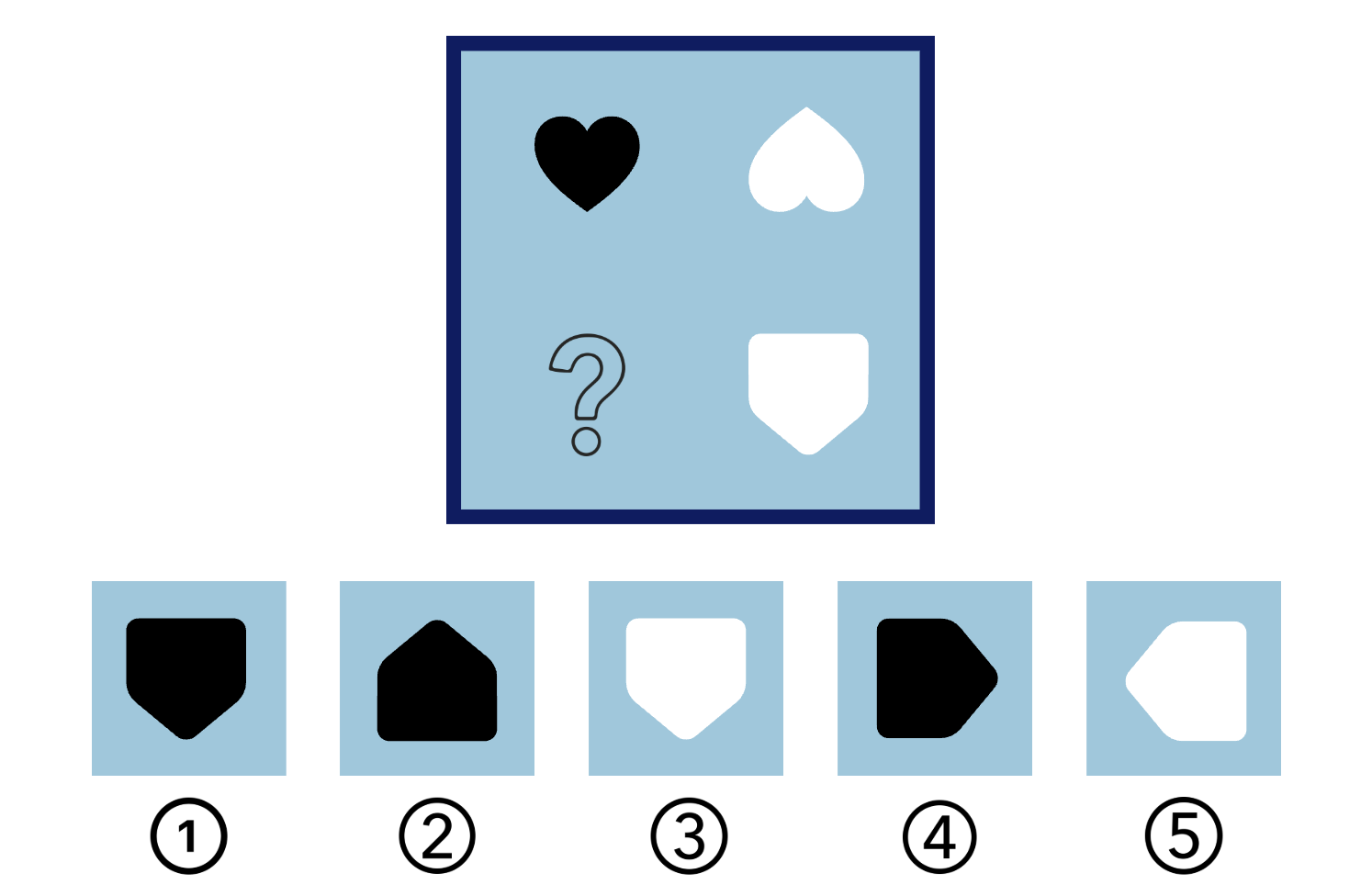
Image Copyright of U2 Tuition
-
Answer: 2
Explanation: The shape flips and changes colour from black to white.
Spatial Reasoning
For many students, Spatial Reasoning is the most unfamiliar part of the CAT4.
Rather than working with words or flat diagrams, students must mentally manipulate objects in three-dimensional space. They may be asked to imagine shapes being rotated, folded or unfolded or identify how simple shapes fit within more complex designs.
The CAT4 assesses spatial reasoning using two question types.
Figure Analysis
Students are shown a piece of paper that has been folded and hole-punched before being unfolded.
They must visualise how the folds work and predict where the holes will appear once the paper has been opened out.
These questions assess mental visualisation, logical reasoning and attention to detail.
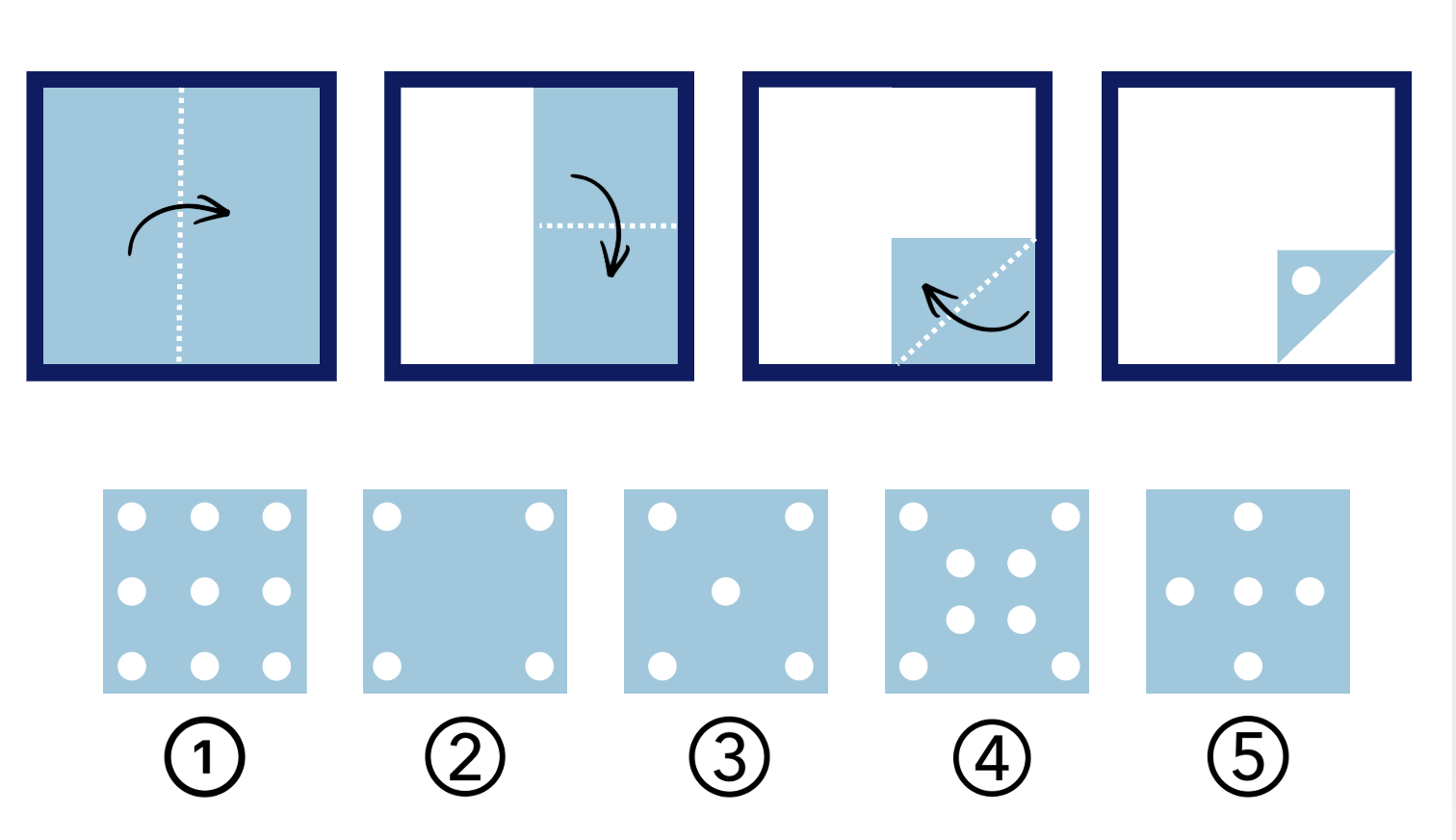
Image Copyright of U2 Tuition
-
Answer: 4
Explanation: The paper is folded in half repeatedly, meaning the dots will form a cross through the middle of the paper.
Figure Recognition
Students are shown a simple shape and asked to identify where it appears within a much more complex design.
Success depends on the ability to ignore distracting information and recognise visual patterns quickly.
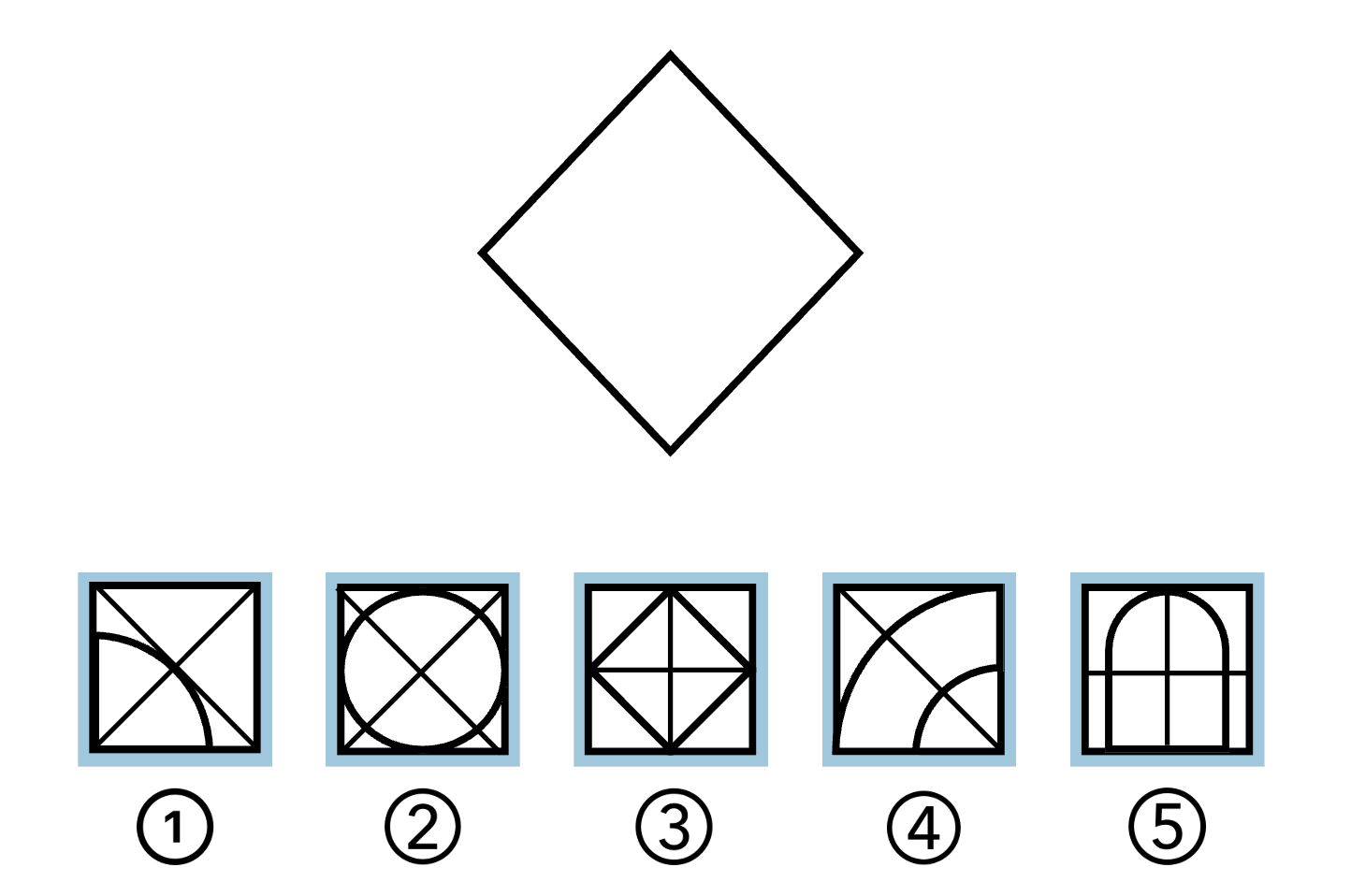
Image Copyright of U2 Tuition
-
Answer: 3
Explanation: The Diamond shape appears in the middle of option 3
Why Take a CAT4 Practice Test?
While the CAT4 doesn’t test taught knowledge, doing a CAT4 practice test can still provide significant benefits:
Reduces anxiety by familiarising your child with question styles.
Improves time management and focus.
Identifies target areas for improvement.
Builds confidence through exposure to new reasoning formats.
The GL Assessment Website offers a few official examples, but they’re limited and there is no complete practice test.
Other familiarisation material:
Use third party material cautiously, as much of it does not accurately reproduce test content.
Be wary of any material that isn't directly from GL Assessments.
Exceptions include resources in partnership with GL Assessments, such as the Kent Test Familiarisation Guide. However, it may still differ from the test your child will sit, especially if they aren't sitting the Kent Test.
The lack of reliable online test material is where expert support and structured mock testing from U2 Tuition can make all the difference. Our tutors possess specialist resources, including mock papers and familiarisation materials, which they employ in their sessions to help students succeed.
How U2 Tuition Helps With CAT4 Success
At U2 Tuition, we specialise in CAT4 tutoring tailored to your child's needs. Our expert tutors don't just teach the test; we guide students in building the cognitive skills behind it.

Access specialist familiarisation resources developed by tutors.
Complete targeted CAT4 mock tests with feedback.
Build key verbal, quantitative, spatial, and non-verbal reasoning skills.
Receive personalised support based on their test performance.
Strengthen core English and maths skills that support reasoning.
Learn strategies for tackling unfamiliar problems.
Get guidance on the next steps, including school options and subject strengths. For example, a high spatial score indicates STEM-related strengths.
We offer online, hybrid, and in-person London tutoring. Please enquire about in-person tutoring in other areas of the UK.
At U2 Tuition, we believe every child deserves the opportunity to succeed. Whether they're sitting the CAT4 in the UK or abroad, we'll support them every step of the way.












16+ interviews are a central part of the admissions process at many of the UK’s leading independent schools and sixth forms. They give admissions teams the opportunity to assess a candidate beyond their academic results, exploring why they want to join the school, their subject interests and extracurricular activities, as well as their communication skills, intellectual curiosity and academic potential.
In this 16+ interview guide, discover how to prepare for common sixth form interview questions, from personal and subject-specific questions to critical thinking, problem-solving and abstract reasoning challenges. We also explore how to approach academic discussions, current affairs questions and the analysis of unfamiliar or unseen material, helping students prepare confidently for even the most challenging 16+ school interviews.