The Ultimate Guide to the ISEB Common Pre-Test (2026)
If your child is applying to one of the UK's leading independent schools, there's a good chance you'll come across the ISEB Common Pre-Test. Used by many of the country's most competitive schools, it is designed to assess a pupil's academic potential before they progress to the next stage of the admissions process.
Unlike traditional entrance examinations, the ISEB Common Pre-Test is adaptive, meaning the difficulty of the questions changes depending on how a child performs. This allows schools to build a more detailed picture of a pupil's ability while reducing the emphasis on simply memorising exam techniques.
For many parents, however, the process can seem confusing. When should children begin preparing? What topics are included? How is the test scored? And how important is the result? In this guide, we'll answer all of these questions, explain exactly what to expect and share practical advice to help your child prepare with confidence.

Contents:
What Is The ISEB Common Pre-Test?
The ISEB Common Pre-Test is an online assessment developed by the Independent Schools Examinations Board (ISEB). It is most commonly taken by pupils in Year 6 or Year 7 applying for entry to independent senior schools, particularly for Year 7, Year 8 or Year 9 (13+) entry.
The assessment is designed to measure a child's academic potential rather than simply test how much they have learnt. It evaluates pupils across four key areas:
English
Mathematics
Verbal Reasoning
Non-Verbal Reasoning
One of the key features of the Pre-Test is that it is adaptive. As your child progresses through the assessment, the computer adjusts the difficulty of the questions based on their answers. This allows schools to build a more accurate picture of each pupil's ability, regardless of whether they are working above or below their age group.
The ISEB Common Pre-Test is usually just one part of the admissions process. Most independent schools will also consider school reports, references, interviews and, in some cases, their own entrance examinations before making a final decision. The Pre-Test helps schools identify pupils with strong academic potential, but it is rarely the only factor considered.
Not sure which entrance assessment your target school uses?
Our expert advisors can help you understand your chosen school's admissions process and recommend the best preparation plan for your child. Book your complimentary 20-minute consultation today.
Which Schools Use the ISEB Common Pre-Test?
The ISEB Common Pre-Test is used by many of the UK's leading independent schools, although every school uses the results slightly differently. Some schools rely on the Pre-Test as an initial screening assessment before inviting pupils to interview, while others combine it with their own entrance examinations or scholarship assessments.
Some notable schools that currently use (as of 2026) the ISEB Common Pre-Test include:
Caterham School
Charterhouse
Downe House School
Eaton Square Upper School
Eton College
Harrodian Senior School
Harrow School
James Allen's Girls' School
Kew House School
Lady Eleanor Holles
Sevenoaks School
St Albans High School
St Dunstan's College
St Paul's School
Westminster School
Wycombe Abbey
As admissions policies can change from year to year, it's always worth checking the latest guidance on each school's website before applying. Some schools may introduce additional assessments or adjust how they use the Pre-Test as part of their admissions process.
What Does the ISEB Common Pre-Test Include?
Understanding the format of the ISEB Common Pre-Test can help both parents and pupils approach the assessment with confidence. While every child receives a unique set of questions due to the adaptive nature of the test, the overall structure remains the same.
The ISEB Common Pre-Test is completed online and is made up of four separate sections, each designed to assess a different area of academic ability:
English
Mathematics
Verbal Reasoning
Non-Verbal Reasoning
Each section is timed, with most lasting around 20–30 minutes, although the exact timings may vary slightly. The assessment is usually completed in one sitting, though some schools may choose to split it across two sessions.
Unlike a traditional paper exam, pupils answer questions on a computer. As they progress through each section, the difficulty of the questions adjusts according to their responses. This means that no two children will receive exactly the same assessment.
English
The English section assesses much more than spelling and grammar. It is designed to evaluate a child's ability to read carefully, interpret information and understand how language is used.
Pupils will typically answer multiple-choice questions based on one or more reading passages. These questions may test:
Reading comprehension
Inference and deduction
Vocabulary in context
Grammar and punctuation
Understanding of language techniques
A strong vocabulary and regular reading habit can make a significant difference in this section. Children who are comfortable analysing a range of fiction and non-fiction texts are often better equipped to identify meaning, tone and the writer's intentions.
Tutor Top Tip: Encourage your child to read widely, including novels, newspapers and magazines and discuss what they've read. Talking about characters, themes and vocabulary helps develop the analytical skills needed for the Pre-Test.
Maths
The Mathematics section focuses on mathematical reasoning rather than simply testing whether pupils can recall formulas or complete routine calculations.
Questions are designed to assess how well children apply mathematical knowledge to solve unfamiliar problems. Topics may include:
Number and place value
Fractions, decimals and percentages
Ratios and proportions
Algebra
Geometry and measures
Data handling and statistics
Many questions require pupils to complete several steps before arriving at the correct answer, making accuracy and logical thinking just as important as mathematical knowledge.
Tutor Top Tip: Rather than repeatedly completing worksheets, encourage your child to explain how they reached an answer. This develops reasoning skills and helps identify any gaps in understanding.
Verbal Reasoning
The Verbal Reasoning section assesses a child's ability to think logically using words and language. Rather than testing knowledge learned at school, it evaluates how well pupils recognise patterns, understand relationships between words and solve language-based problems.
Children may come across questions involving:
Synonyms and antonyms
Letter and number codes
Word sequences
Analogies
Vocabulary
Logical reasoning
A broad vocabulary is one of the biggest advantages in this section. Children who read regularly and encounter a wide range of language often find it easier to identify word meanings and relationships.
It's worth remembering that Verbal Reasoning is a skill that develops over time. Regular exposure to different question types, alongside vocabulary-building activities, can significantly improve both confidence and accuracy.
Tutor Top Tip: Encourage your child to learn a few new words each week and use them in everyday conversation. Building vocabulary gradually is far more effective than trying to memorise long word lists shortly before the test.
Non-Verbal Reasoning
The Non-Verbal Reasoning section measures a child's ability to identify patterns, think spatially and solve visual problems. Unlike the other sections of the ISEB Common Pre-Test, it doesn't rely on language or mathematical knowledge, making it a useful way for schools to assess logical thinking and problem-solving skills.
Questions often include:
Shape sequences
Pattern recognition
Rotations and reflections
Symmetry
Matrices
Visual puzzles
Many children are unfamiliar with Non-Verbal Reasoning when they first begin preparing for the ISEB Common Pre-Test. However, confidence usually grows quickly once they understand the different question styles and develop strategies for spotting patterns efficiently.
Regular practice is key, but it's equally important for children to understand why an answer is correct rather than simply memorising methods.
Tutor Top Tip: Encourage your child to explain how they identified a pattern before moving on to the next question. This helps reinforce logical thinking and reduces careless mistakes.
How Does Adaptive Testing Work?

One of the most distinctive features of the ISEB Common Pre-Test is that it is computer-adaptive. Unlike a traditional exam where every pupil answers exactly the same questions, the Pre-Test adjusts the level of difficulty as your child progresses through each section.
One of the most distinctive features of the ISEB Common Pre-Test is that it is computer-adaptive. Unlike a traditional exam where every pupil answers exactly the same questions, the Pre-Test adjusts the level of difficulty as your child progresses through each section.
If a pupil answers several questions correctly, they are likely to receive more challenging questions. If they answer incorrectly, the assessment will adapt by presenting questions that are more appropriate to their current level.
This adaptive format helps schools gain a more accurate understanding of each child's academic ability, rather than simply measuring how many questions they answered correctly.
Because every child's test is different, it's impossible to compare questions or scores directly with friends who have taken the assessment. Instead, schools receive a standardised score that reflects a pupil's performance relative to others of the same age.
For parents, this means there's no benefit in trying to "predict" the questions that will appear. The best preparation focuses on developing strong underlying skills in English, Maths and Reasoning so that children are confident tackling unfamiliar questions.
Preparing for the ISEB Common Pre-Test?
Because the ISEB Common Pre-Test is adaptive, every child's assessment is different. That's why effective preparation focuses on building strong academic foundations rather than simply memorising question types.
Our experienced tutors provide personalised preparation for the ISEB Common Pre-Test, helping pupils develop confidence across English, Mathematics, Verbal Reasoning and Non-Verbal Reasoning.
Book your free 20-minute consultation today to find out how we can help your child prepare with confidence.
How Is the ISEB Common Pre-Test Scored?
The results of the ISEB Common Pre-Test are provided directly to the schools your child has applied to. Unlike many school exams, parents are not usually given a detailed breakdown of marks or individual question scores.
Instead, schools receive a Standard Age Score (SAS). This scoring system takes into account:
Your child's age
The difficulty of the questions they answered
Their overall performance compared with other pupils of the same age
This helps ensure that younger pupils within the year group are assessed fairly alongside older applicants.
It's important to remember that there is no universal pass mark for the ISEB Common Pre-Test. Each independent school decides how it uses the results as part of its admissions process.
Some schools use the Pre-Test as an initial screening assessment before inviting pupils to interview, while others consider it alongside school reports, references, interviews and their own entrance examinations. The Pre-Test is therefore just one part of a holistic admissions process.
When Should My Child Start Preparing?
One of the questions we're asked most frequently at U2 Tuition is "When should my child start preparing for the ISEB Common Pre-Test?"
The answer depends on your child's current academic level, confidence and target schools. While every child is different, starting preparation early allows skills to develop naturally and avoids the pressure of last-minute revision.
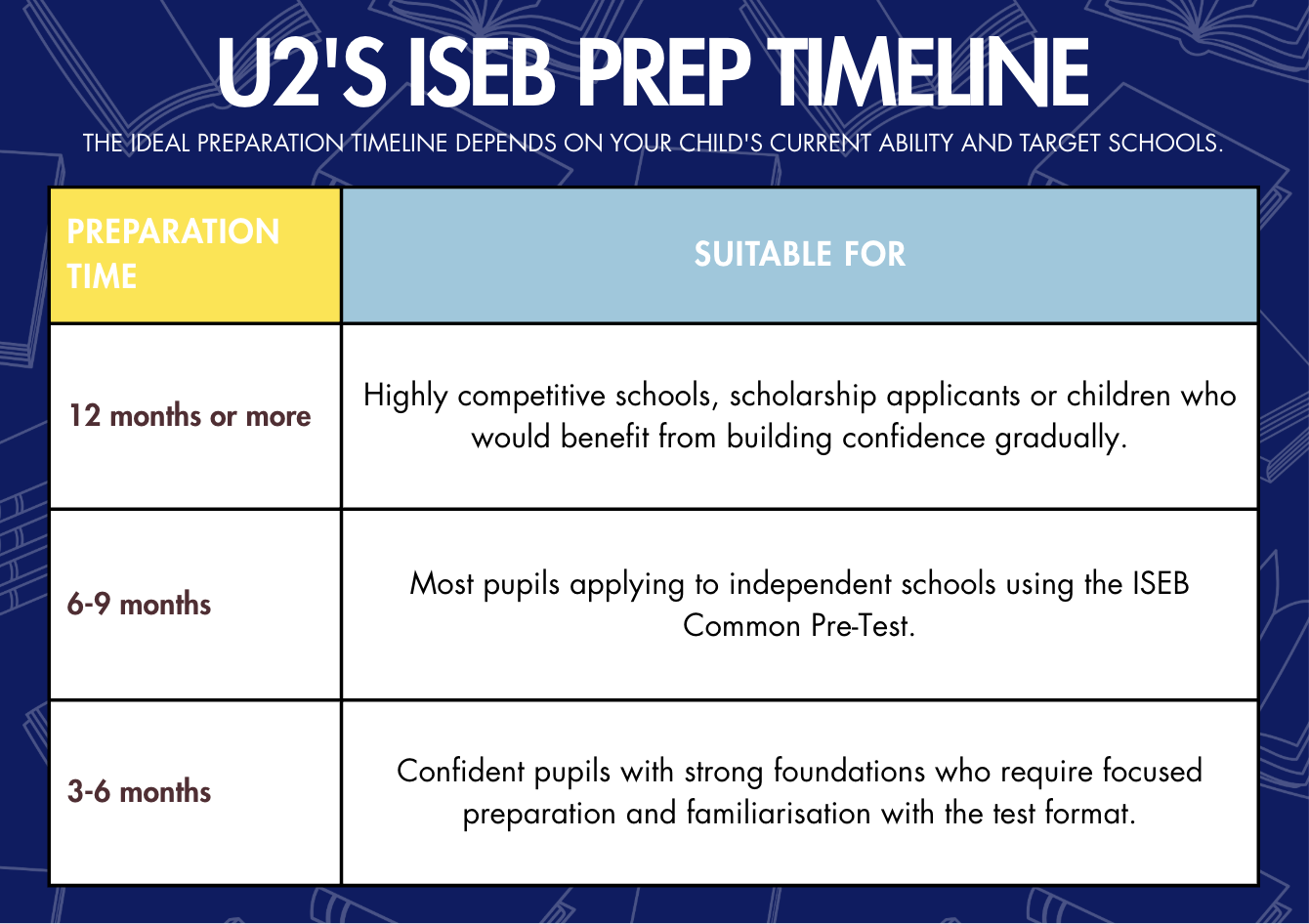
Early preparation doesn't mean studying every day. Short, consistent practice sessions, combined with regular reading and exposure to reasoning questions, are often far more effective than intensive revision in the weeks before the assessment.
Parents should also remember that preparation isn't just about completing practice papers. Developing vocabulary, reading widely and strengthening problem-solving skills can all have a significant impact on a child's performance.
Top Tips for Preparing for the ISEB Common Pre-Test
Preparing for the ISEB Common Pre-Test is about much more than completing practice papers. Because the assessment is adaptive, children need to develop strong underlying skills in English, Mathematics and Reasoning, rather than simply memorising answers.
Here are some of our top tips to help your child prepare effectively.
Start Preparation Early
One of the biggest advantages you can give your child is time. Starting preparation several months in advance allows them to build confidence gradually, identify weaker areas and improve without feeling overwhelmed.
Rather than cramming in the weeks before the assessment, aim for short, regular study sessions that fit naturally into your child's routine. Consistency is far more effective than intensive revision.
Encourage Regular Reading
Reading is one of the best ways to prepare for the ISEB Common Pre-Test, particularly the English and Verbal Reasoning sections.
Reading widely helps children to:
Develop a richer vocabulary
Improve comprehension skills
Strengthen inference and analytical thinking
Become familiar with different writing styles
Encourage your child to read a mixture of fiction and non-fiction, including newspapers, magazines and biographies, as well as novels appropriate for their age.
Build Vocabulary Naturally
A strong vocabulary underpins success in several parts of the ISEB Common Pre-Test.
Instead of memorising long lists of words, encourage your child to keep a vocabulary notebook. Whenever they come across an unfamiliar word, ask them to look up the meaning and then use it in a sentence. Revisiting new vocabulary regularly will help it become part of their everyday language.
Small, consistent improvements over time are much more effective than trying to learn hundreds of new words just before the assessment.
Practise Under Timed Conditions
Once your child feels confident with the different question types, begin introducing timed practice.
Working under realistic time limits helps pupils:
Improve their pace
Build exam confidence
Develop time management skills
Become familiar with answering questions under pressure
However, timed practice should come after children understand the content. Accuracy should always come before speed.
Review Mistakes Carefully
Completing practice papers is only useful if children take the time to understand their mistakes.
After each practice session, encourage your child to review any incorrect answers and ask questions such as:
Why was this answer incorrect?
Which skill was being tested?
Was the mistake caused by misunderstanding, vocabulary or rushing?
Learning from mistakes is one of the fastest ways to improve performance and confidence.
Consider Expert Support
Every child learns differently. While some pupils are happy preparing independently, others benefit from structured support from an experienced tutor.
A specialist ISEB tutor can:
Identify strengths and areas for improvement
Create a personalised preparation plan
Introduce effective exam strategies
Build confidence through targeted practice
At U2 Tuition, our experienced tutors have helped pupils gain places at many of the UK's leading independent schools, providing tailored support for every stage of the admissions process.
Explore Our 11+ & 13+ Tuition
Preparing for the ISEB Common Pre-Test is just one part of the independent school admissions journey. Our specialist 11+ Tuition and 13+ Tuition programmes are designed to help pupils build confidence across English, Mathematics, Verbal Reasoning and Non-Verbal Reasoning while preparing for the assessments used by leading independent schools.
Find out more about our 11+ and 13+ tuition services, or book a complimentary 20-minute consultation with one of our expert advisors today.
The Best Resources for ISEB Common Pre-Test Preparation
Preparing for the ISEB Common Pre-Test doesn't have to mean working through endless practice papers. The most effective preparation combines high-quality resources with regular reading, vocabulary development and targeted practice in areas where your child needs the most support.
Below are some of our favourite resources to help children prepare with confidence.
Official ISEB Familiarisation Materials
Before diving into revision, it's important that your child understands how the ISEB Common Pre-Test works. The ISEB provides official familiarisation materials that introduce pupils to the format of the assessment, the different question styles and the computer-based interface.
These resources aren't designed as revision materials, but they are an excellent way to reduce nerves and help children feel comfortable before sitting the test.
Top Tip: We recommend working through the familiarisation materials before starting regular practice, so your child knows what to expect from the assessment.
ISEB Practice Papers
Practice papers remain one of the best ways to prepare for the ISEB Common Pre-Test, particularly once your child has built strong foundations in English, Maths and Reasoning.
Completing practice papers helps pupils to:
Become familiar with different question styles
Develop exam technique
Improve time management
Build confidence under timed conditions
Rather than completing lots of papers in quick succession, encourage your child to review their answers carefully and learn from any mistakes before moving on to the next one.
Top Tip: Many providers such as BOND and CGP produce ISEB-style past papers in Maths, English, Verbal and Non-Verbal Reasoning.
Reading and Vocabulary
Reading regularly is one of the most effective ways to prepare for the English and Verbal Reasoning sections of the ISEB Common Pre-Test.
Encourage your child to read a wide variety of texts, including:
Classic children's literature
Contemporary fiction
Newspapers and magazines
Biographies and non-fiction books
Reading widely exposes children to richer vocabulary, different writing styles and more complex sentence structures, all of which can improve comprehension and reasoning skills.
Keeping a vocabulary notebook is another simple but highly effective way to build confidence over time.
Online Learning Resources
There are a number of excellent online resources that can support your child's preparation alongside schoolwork.
For Mathematics, platforms such as Atom Learning, White Rose Maths and CGP offer clear explanations, worksheets and videos covering key topics.
For English, encouraging regular reading, comprehension exercises and vocabulary-building activities can be just as valuable as completing formal practice papers.
Reasoning skills can also be developed through puzzles, logic games and age-appropriate brain teaszers, helping children become more confident at recognising patterns and solving unfamiliar problems.
Specialist Tutors
Every child has different strengths and areas for development. While some pupils are happy preparing independently, others benefit from personalised support from an experienced tutor.
A specialist ISEB tutor can:
Identify strengths and weaker areas
Create a tailored preparation plan
Introduce effective exam strategies
Build confidence through regular feedback
Adapt lessons to suit your child's learning style
At U2 Tuition, our experienced 11+ and 13+ tutors have helped pupils gain places at many of the UK's leading independent schools. Whether your child needs support in English, Mathematics, Verbal Reasoning or Non-Verbal Reasoning, our personalised approach ensures they receive targeted preparation based on their individual needs.
Looking For An ISEB Tutor For Your Child?

At U2 Tuition, we specialise in preparing pupils for the ISEB Common Pre-Test and a wide range of 11+ and 13+ entrance assessments. Our experienced tutors have successfully supported students applying to many of the UK's leading independent schools, combining subject expertise with a thorough understanding of the admissions process.
We know that every child learns differently, which is why our approach is entirely personalised. We take the time to understand each student's strengths, identify areas for development and create a tailored learning plan that builds both academic ability and confidence.
Our specialist tutors provide expert support across English, Mathematics, Verbal Reasoning and Non-Verbal Reasoning, helping pupils become familiar with the adaptive format of the ISEB Common Pre-Test while developing the core skills needed to succeed. Alongside subject knowledge, we focus on exam technique, time management and problem-solving strategies, ensuring students feel confident and well prepared on the day of the assessment.
Whether your child is just beginning their preparation or aiming for a place at one of the UK's most competitive independent schools, we're here to help them reach their full potential.
Book a complimentary 20-minute consultation today to discuss your child's goals and discover how our specialist 11+ and 13+ tutors can support their ISEB Common Pre-Test preparation.