

GL 11+ Assessment Guide: What Parents Need to Know and How to Prepare
If your child is applying to a grammar school or selective independent school, there's a good chance they'll sit the GL Assessment 11+ exam. So, what exactly does it involve and how can you help your child prepare with confidence?
One of the biggest misconceptions about the GL 11+ is that it's "just like a school test." In reality, it combines curriculum knowledge in English and Maths with two less familiar reasoning papers, Verbal Reasoning and Non-Verbal Reasoning, sat under strict timed conditions and marked using a separate answer sheet.
At U2 Tuition, we help students across the UK prepare for the GL 11+ used by grammar schools, consortia and independent schools, building the subject knowledge, reasoning skills and exam technique needed to perform at their best.

Contents:
What Is The GL Assessment?
GL Assessment (short for Granada Learning) is one of the UK's leading providers of school entrance exams and its 11+ test is the most widely used admissions assessment for state grammar schools in England, as well as a number of selective independent schools.
Unlike the CAT4, which measures underlying cognitive ability, the GL 11+ combines academic attainment in English and Maths with reasoning skills in Verbal and Non-Verbal Reasoning. This means it tests both what a child has learned at school and how well they can think on their feet with unfamiliar problems.
The format is standardised and multiple-choice throughout, which makes it more predictable to prepare for than some alternative 11+ providers. However, the sheer breadth of content (four separate papers, each under tight time pressure), means thorough preparation still makes a real difference.
What Does the GL 11+ Exam Assess?
The GL 11+ is made up of four separate papers:
English ➡️ reading comprehension, vocabulary, spelling, punctuation and grammar.
Maths ➡️ arithmetic, problem-solving, fractions, shape and space, data handling.
Verbal Reasoning ➡️ solving problems using words, codes and language patterns.
Non-Verbal Reasoning ➡️ recognising patterns, sequences and relationships between shapes.
Each paper typically lasts 45-60 minutes, and a full GL 11+ assessment can include around 260 questions in total across all four subjects. Every paper is multiple-choice, and answers are recorded on a separate answer sheet, which is itself a skill children need to practise.
Results are returned as a Standardised Age Score (SAS), which adjusts a child's raw score according to their exact age in months. This means a child born in August isn't disadvantaged compared with a classmate born the previous September; both are compared fairly against children of a similar age.
How is the GL 11+ Scored?
This is one of the questions parents ask us most, so it's worth explaining clearly.
GL Assessment converts each child's raw marks into a standardised age score (SAS), using a scale with a mean of 100 and a standard deviation of 15. In practice, this means:
A score of 100 represents exactly average performance for that age group nationally.
Scores typically range from around 69 to 141.
A score of 110 sits roughly at the 75th percentile; 121 sits around the 91st percentile.
There is no single national pass mark. Each local authority, consortium or school sets its own qualifying score, based on the number of grammar school places available and how that year's cohort performed. A score that comfortably secures a place in one county may fall short in a more competitive area, so it's essential to check the specific threshold published by your target school or local authority rather than relying on a generic benchmark.
For heavily oversubscribed, super-selective schools, simply clearing the pass mark isn't enough; places go to the highest-ranking candidates, so every additional point matters.
GL Assessment vs CEM: What's the Difference?
Alongside GL, the other major 11+ test provider is CEM (Centre for Evaluation and Monitoring), now part of Durham University. If you're not yet sure which your target school or area uses, here's how the two compare:
The key takeaway for parents: check which provider your target school or local authority actually uses, since this shapes which practice materials and preparation approach will genuinely help. Many areas that previously used CEM have moved over to GL in recent years, so it's worth confirming current information rather than relying on what an older sibling may have sat.
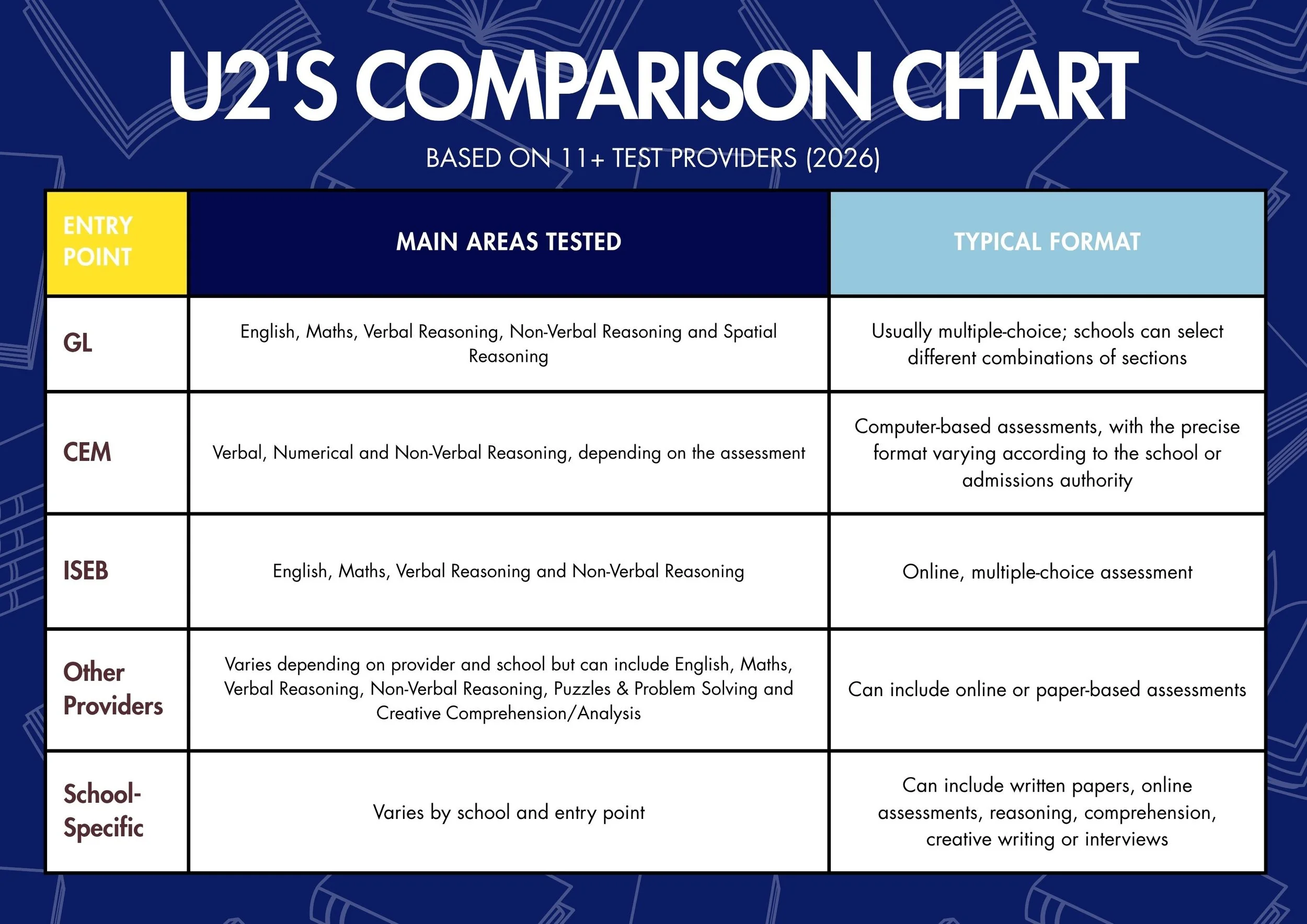
Image Copyright of U2 Tuition.
Which Schools and Areas Use the GL 11+ Exam?
GL Assessment is used by the majority of grammar school consortia in England, including areas such as Kent, Buckinghamshire, Lincolnshire, Essex and several outer London boroughs. Many run their own branded version of the test, for example the Kent Test or the Medway Test, which follow GL's format but may include local variations. Some selective independent schools also use GL papers, either alone or alongside their own subject papers and interviews.
Because every consortium and school customises the test slightly differently, in subjects included, timings and pass marks, it's essential to check the specific requirements published by your local authority or target school.
Looking for GL 11+ Tuition for your child? Book a Free 20 min Consultation with one of our Expert Academic Advisors today for information on GL 11+ Tuition for all levels!
When Do Students Sit the GL 11+?
Most children sit the GL 11+ in September of Year 6, for entry to grammar school the following September, although exact dates vary by local authority. Registration typically needs to be completed the previous June or July, while children are still in Year 5, so it's important to check deadlines well in advance.
A sensible preparation timeline looks something like this:
Year 4 - early Year 5: build strong foundations in reading, vocabulary, arithmetic and problem-solving; there's no substitute for solid core skills.
Spring/summer term, Year 5: introduce the four GL question types, starting with short, regular sessions on Verbal and Non-Verbal Reasoning.
Summer holidays before Year 6: begin timed practice papers, gradually increasing from one a fortnight to one or two a week.
Autumn term, Year 6: complete full GL-style mock exams under timed conditions, review mistakes closely, and taper off in the final week before the real test.
Looking for more? Take a look at some of U2 Tuition’s other 11+ resources to help your child at whatever stage of preparation they’re currently at:
What Subjects Are Included In The GL 11+?
Each of the four GL 11+ papers tests a distinct set of skills. Below, we've broken down what to expect in each one, along with example-style questions.
English
The English paper assesses reading comprehension, vocabulary, and spelling, punctuation and grammar (SPAG). A typical paper includes a comprehension passage followed by multiple-choice questions, alongside a cloze (gap-fill) exercise and short SPAG-focused tasks.
Depending on the specific assessment, children may encounter questions involving:
Reading comprehension
Vocabulary
Spelling
Grammar
Punctuation
Sentence structure
Understanding meaning and context
Strong performance depends on wide reading, a broad vocabulary, and the ability to read carefully under time pressure, since many questions test inference and deduction rather than facts stated directly in the text.
Example Question:
Choose the word that best completes the sentence.
Despite the storm, the sailors remained ________and guided the boat safely to shore.
A) Anxious B) Composed C) Reckless D) Confused E) Distracted
-
Answer: B) Composed
Explanation: The sentence describes the sailors succeeding "despite the storm," which suggests they stayed calm rather than anxious, reckless or confused.
How can you prepare for GL 11+ English?
Strong reading skills are at the heart of GL 11+ English preparation. Children need to feel comfortable reading unfamiliar passages, identifying key information and using context to work out the meaning of new words.
One of the best ways to develop these skills is through regular, varied reading. Encourage your child to read a mixture of fiction and non-fiction, and take the opportunity to discuss what they have read. Asking questions about the text, exploring unfamiliar vocabulary and encouraging your child to explain their answers can all help strengthen comprehension and language skills.
A broad vocabulary is particularly valuable, as children may need to identify synonyms, antonyms or the most appropriate meaning of a word based on its context.
As the exam approaches, it can also be helpful to introduce timed comprehension and English practice. This allows children to become familiar with working accurately under time pressure while building confidence with the types of questions they are likely to encounter.
Maths
The Maths paper covers the full Key Stage 2 curriculum, and sometimes stretches a little beyond it. Expect questions on arithmetic, fractions and decimals, ratio, shape and space, measures, data handling and multi-step word problems.
Questions can require children to apply their knowledge rather than simply recall a mathematical rule. Children therefore need both secure mathematical foundations and the ability to reason through unfamiliar problems.
Areas that may be relevant include:
Number
The four operations
Fractions, decimals and percentages
Measurement
Geometry
Data handling
Problem-solving
Mathematical reasoning
Because the paper is multiple-choice and tightly timed, speed and accuracy matter just as much as understanding; children need to be able to work efficiently and check their answers against the options given.
Example Question:
A recipe uses 250g of flour to make 12 biscuits. How much flour is needed to make 30 biscuits?
A) 500g B) 575g C) 600g D) 625g E) 750g
-
Answer: D) 625g
Explanation: 250g ÷ 12 = 20.83g per biscuit (or use ratio: 30 ÷ 12 = 2.5, so 250g × 2.5 = 625g).
How can you prepare for GL 11+ Maths?
Start by identifying any gaps in your child's core mathematical knowledge.
Once the fundamentals are secure, move towards more challenging problem-solving questions. Encourage your child to understand why an answer is correct rather than simply memorising procedures.
Timed practice can then be introduced gradually. The aim is not simply to make a child work faster, but to help them develop the confidence to make quick and accurate decisions.
Verbal Reasoning
Verbal Reasoning tests how well a child can solve problems using words, letters and codes. GL's Verbal Reasoning paper draws on a bank of around 20 different question types, so familiarity with the formats is genuinely valuable preparation, not just "teaching to the test."
GL Assessment describes VR as assessing skills including processing verbal information, recognising similarities and differences, identifying patterns and understanding the rules and meaning of language.
Children may encounter questions involving:
Synonyms and antonyms
Word relationships
Analogies
Letter and number sequences
Codes
Odd-one-out questions
Word-based logic problems
Example Question:
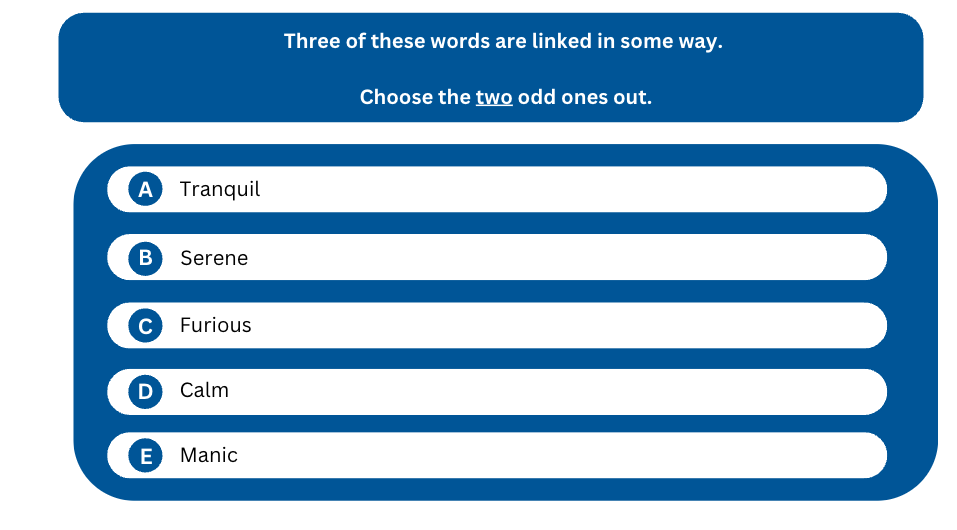
Image Copyright of U2 Tuition.
-
Answer: Furious and Manic
Explanation: Tranquil, Serene and Calm are adjectives that describe peaceful, quiet or relaxed states. Furious and Manic both describe intense, fast-paced or highly energetic states, making them the odd ones out.
How can you prepare for GL 11+ Verbal Reasoning?
Verbal Reasoning can feel unfamiliar at first, as children may encounter question types that they have not covered in their usual schoolwork. Preparation should therefore begin by helping your child become comfortable with the different types of questions and understand the techniques needed to solve them.
Developing a strong vocabulary is particularly important. Encourage your child to read widely and explore unfamiliar words, including their meanings, synonyms and antonyms. Regular practice with word relationships, codes, sequences, analogies and other common Verbal Reasoning questions can also help children recognise patterns more quickly.
Once your child is confident with the different question types, introduce timed practice to develop speed and accuracy. Reviewing mistakes is equally valuable, as it allows children to understand where they went wrong and recognise similar patterns when they encounter them again.
Non-Verbal Reasoning
Non-Verbal Reasoning removes words and numbers almost entirely, testing a child's ability to spot patterns, sequences and relationships between shapes and diagrams. GL's Non-Verbal Reasoning paper usually contains around 80 questions, split into four timed sections of 20, with all children moving on to the next section together.
GL Assessment describes Non-Verbal Reasoning as involving skills such as processing graphic information, recognising patterns and rules, applying concepts such as rotation, reflection and symmetry, and using spatial awareness and logical problem-solving.
Children may be asked to:
Identify patterns
Complete sequences
Find the missing shape
Recognise rotations
Identify reflections
Work with symmetry
Spot relationships between shapes
Apply visual rules
For children who have never encountered these questions before, the format can initially seem very unfamiliar. The good news is that these are skills that can become much more accessible with appropriate practice.
Example Question:
Pick one of the five boxes below that contains the missing shape.
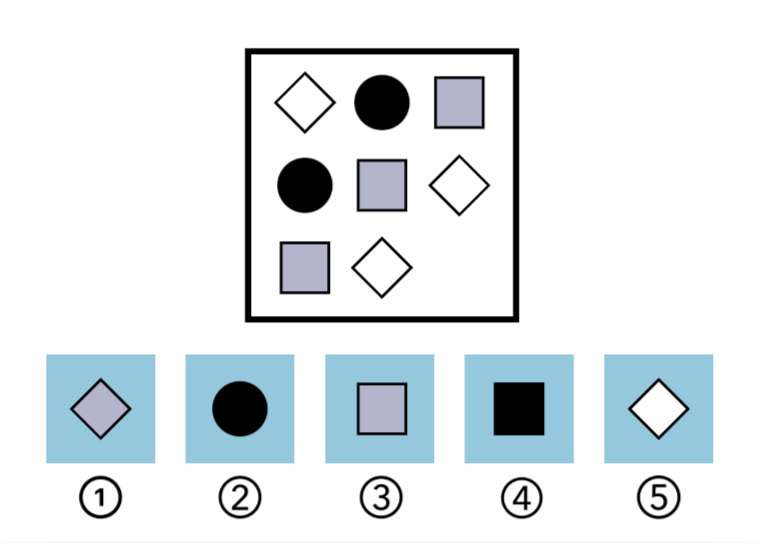
Image Copyright of U2 Tuition.
-
Answer: The correct answer is 2.
Explanation: The pattern is based on the three different shapes:
◇ White diamond
● Black circle
■ Grey square
Each row and each column contains one of each shape.
Looking at the grid:
Row 1: white diamond → black circle → grey square
Row 2: black circle → grey square → white diamond
Row 3: grey square → white diamond → black circle
So the missing shape must be a black circle.
Therefore, the answer is option 2.
How can you prepare for GL 11+ Non-Verbal Reasoning?
Non-Verbal Reasoning requires children to identify patterns, relationships and rules using shapes and visual information. As these question types can be unfamiliar, it is helpful to introduce them gradually and focus on understanding before putting children under time pressure.
Children should become familiar with concepts such as rotation, reflection, symmetry, sequences, shape relationships and identifying the odd one out. Encourage your child to explain the rule they have spotted rather than simply selecting an answer, as this helps develop their underlying reasoning skills.
Regular practice across a range of question types will help children become more confident and efficient. As the exam approaches, timed questions and practice papers can be introduced to develop speed and accuracy, while reviewing incorrect answers can help identify particular areas that need further work.
Why Take a GL 11+ Practice Test?
Because the GL 11+ covers so much ground across four papers, regular timed practice is one of the most effective things a family can do. Practice testing helps to:
Build familiarity with all four question formats, especially the less intuitive Verbal and Non-Verbal Reasoning styles.
Improve speed and accuracy under real exam time pressure.
Identify specific weak areas to target before the real test.
Build confidence with the multiple-choice format and separate answer sheet.
Reduce exam-day anxiety through repeated, realistic exposure.
GL Assessment publishes a small number of official familiarisation papers, a useful starting point, but they're limited in number and don't give a complete picture of a child's readiness. Third-party materials vary enormously in quality, so it's worth being selective about what you use.
This is where expert guidance and structured mock testing pay off. Our tutors use specialist GL-style practice papers and familiarisation resources in sessions to build both skill and confidence ahead of the real exam.
GL 11+ Frequently Asked Questions
What is a good GL 11+ score?
There's no single "good" score, since pass marks vary by area and school. As a general guide, a standardised score of 110 sits around the 75th percentile nationally, while 121+ sits around the 91st percentile and is typically needed for the most competitive grammar schools.
How many papers does the GL 11+ have?
Four: English, Maths, Verbal Reasoning and Non-Verbal Reasoning, each sat separately and typically lasting 45–60 minutes.
Can you prepare for the GL 11+, or is it "tutor-proof"?
Yes, you can and should prepare. Unlike some CEM-style tests designed to resist coaching, GL's format is consistent and well-documented, so familiarity with the four question types and regular timed practice make a genuine difference.
When should my child start preparing for the GL 11+?
Most families begin building core English and Maths foundations from Year 4, with focused GL-specific preparation, introducing the four question types and timed practice papers, starting from Year 5.
Does the GL 11+ have a fixed pass mark?
No. Each local authority, consortium or school sets its own qualifying score each year, based on the number of places available and how that year's applicants performed, so thresholds vary by region and by year.
How U2 Tuition Helps With GL 11+ Success
At U2 Tuition, we specialise in GL 11+ tutoring tailored to your child's target school and current ability. Our expert tutors don't just drill practice papers; they build the underlying English, Maths and reasoning skills the test relies on. We offer online, hybrid, and in-person London tutoring. Please enquire about in-person tutoring in other areas of the UK.

A U2 Tuition 11+ Tutor can help students to;
Complete timed mock exams across all four papers, with detailed feedback.
Build core English and Maths fluency alongside Verbal and Non-Verbal Reasoning technique.
Receive personalised support based on ongoing performance and target school requirements.
Learn exam strategies, including time management and answer-sheet technique.
Get guidance on next steps, including which schools and consortia best suit your child's strengths.
At U2 Tuition, we believe every child deserves the chance to put their best foot forward. Whatever grammar school or consortium your child is applying to, we'll support them every step of the way.










16+ interviews are a central part of the admissions process at many of the UK’s leading independent schools and sixth forms. They give admissions teams the opportunity to assess a candidate beyond their academic results, exploring why they want to join the school, their subject interests and extracurricular activities, as well as their communication skills, intellectual curiosity and academic potential.
In this 16+ interview guide, discover how to prepare for common sixth form interview questions, from personal and subject-specific questions to critical thinking, problem-solving and abstract reasoning challenges. We also explore how to approach academic discussions, current affairs questions and the analysis of unfamiliar or unseen material, helping students prepare confidently for even the most challenging 16+ school interviews.