

Oxford Admissions Tests Update: TMUA, ESAT & What Applicants Need to Know
Oxford has announced significant changes to its undergraduate admissions tests. For many STEM applicants, this means a shift away from long-standing subject-specific tests like the MAT and PAT towards newer, standardised assessments: the TMUA and ESAT. TARA has also replaced the TSA.
Applicants to applicable courses should prepare for the updated test. Note that previous resources and past papers (e.g. PAT past or specimen papers) can still be helpful if utilised effectively.

Oxford’s Shift From MAT to TMUA
Oxford has begun replacing the Mathematics Admissions Test (MAT) for specific courses with the TMUA.
The TMUA is designed to assess:
Mathematical reasoning
Logical thinking
Problem-solving under time pressure
Fluency with core A-Level mathematical concepts (primarily AS-level content)
Unlike the MAT, which often tests syllabus depth and extended problem-solving, the TMUA emphasises structured reasoning and precision.
Why the change?
From the 2026 admissions cycle, Oxford will adopt the TMUA. This decision reflects a broader move towards tests that assess reasoning and mathematical thinking rather than solely syllabus depth.
It also aligns Oxford with other top UK universities already using the TMUA, hopefully reducing the number of admissions tests applicants must sit for specific subjects.
The TMUA is already in use at Cambridge (for Economics courses), Warwick, LSE, and at many other universities! This means there are already lots of great resources out there.

Applicants to the following courses will be required to sit the TMUA:
Computer Science
Computer Science and Philosophy
Mathematics/Mathematics and Statistics
Mathematics and Computer Science
Mathematics and Philosophy
If you’re wondering:
What does TMUA stand for?
Which UK universities require TMUA?
Is TMUA harder than MAT?
How do you prepare for TMUA?
We’ve written a full guide: Read our complete TMUA Guide
This includes:
TMUA Paper 1 vs Paper 2 explained
How scoring works
Past papers and practice resources
Preparation strategy
Oxford’s Adoption of the ESAT (Replacing PAT and BMSAT)
For several science and engineering courses, Oxford has introduced the ESAT, replacing the Physics Admissions Test (PAT) and the Biomedical Sciences Admissions Test (BMSAT).
As with the adoption of the TMUA, the decision has been made to streamline test provision.

Applicants to the following courses will be required to sit the ESAT:
Biomedical Sciences
Engineering Science
Physics
Physics and Philosophy
Note that Material Sciences previously required the PAT, but there has been no suggestion so far that it will take up the ESAT.
The ESAT assesses both subject knowledge and analytical reasoning in a timed, modular format. Candidates are required to solve problems across a range of scientific contexts and must sit two or three modules, depending on their chosen course:
Mathematical reasoning (Compulsory)
1 or 2 modules from this list: Biology, Chemistry, Physics, or Mathematics 2
The exact combination of modules depends on the course you’ve applied for.
For subjects that previously used the PAT, applicants are likely to be required to take the Physics and Maths II modules.
For Biomedical Sciences, it will likely be Biology and Chemistry modules.
To learn the answers to the following questions, check out our guide to approaching the ESAT.
What is the ESAT test for?
What is a good ESAT score?
What is the grading system for ESAT?
Where can I find ESAT past papers?
How should I prepare for the ESAT?
Because ESAT is relatively new, the preparation strategy is even more critical. Alongside specimen papers and module guides, UAT-UK has compiled past papers from previous test formats, such as the NSAA, which may be helpful. There is a wealth of BMSAT and PAT resources that should not be overlooked, especially in the coming years, whilst the test is still relatively new.
TMUA and ESAT: What’s Changed?
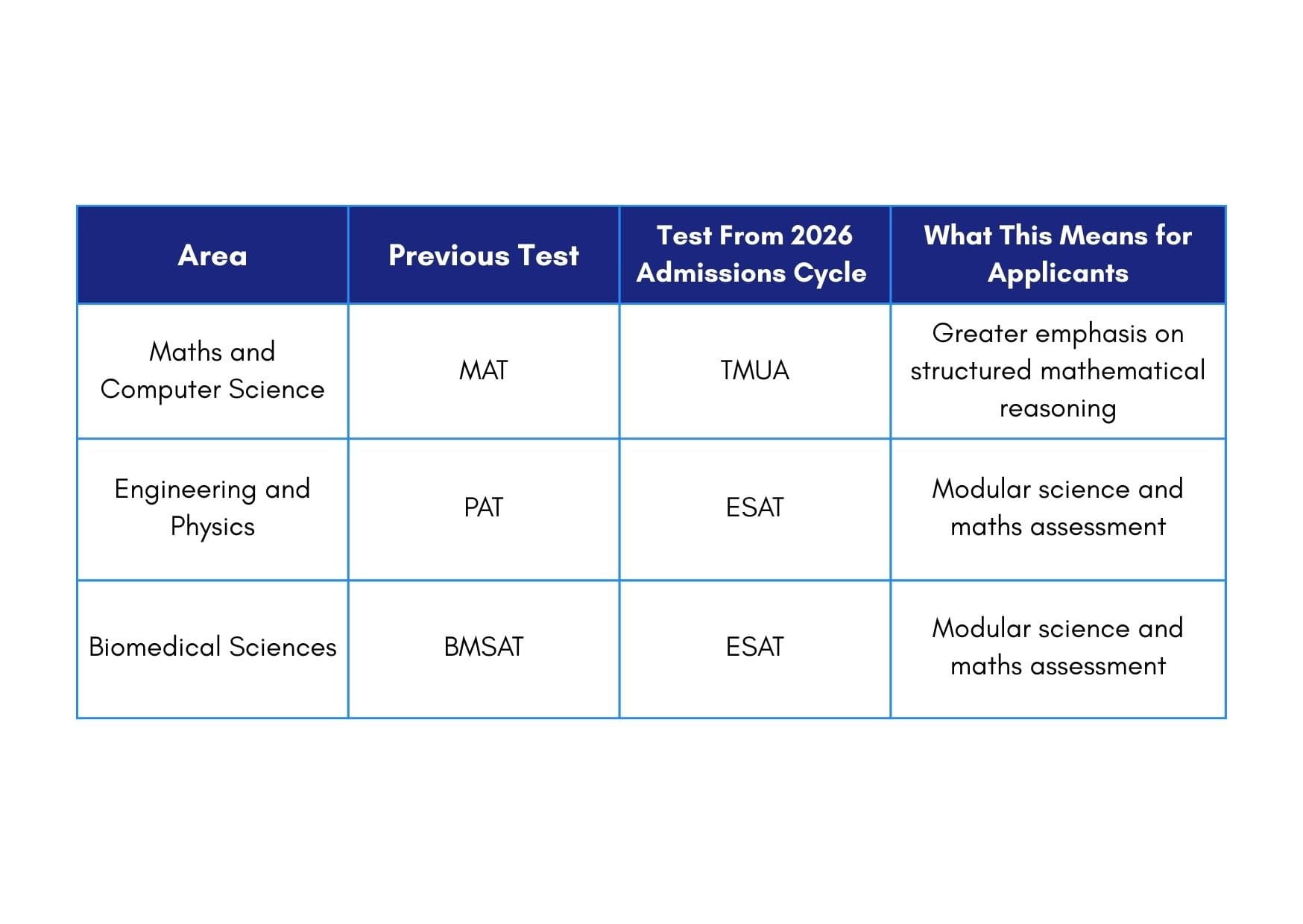
Some of the biggest test changes have to do with format:
The MAT consisted of a single 2.5-hour paper with 27 questions. 25 were multiple-choice questions, and 2 were longer questions.
Now, the TMUA is 2 75-minute papers, each containing 20 multiple-choice questions.
The PAT was a 2-hour test comprising a mixture of Maths and Physics questions. There were typically 40 questions. From 2024, these were multiple-choice only.
Now, applicants must sit 2 to 3 40-minute modules, each containing 27 multiple-choice questions.
The BMSAT required applicants to complete 80 questions (split into four equal subject sections) in 90 minutes.
Now, applicants must sit 2 to 3 40-minute modules, each containing 27 multiple-choice questions.
Students will now face tests with more time-pressured, compartmentalised sections. In general, the new test formats also place greater emphasis on reasoning than on subject-specific content knowledge.
Where Does TARA Fit In?

Alongside TMUA and ESAT, Oxford has also introduced the TARA (Test of Academic Reasoning for Admissions) for specific humanities and social science courses.
TARA will replace the TSA (Thinking Skills Analysis) for the following courses:
Economics and Management
History and Economics
History and Politics (tbc)
Human Sciences
PPE (Politics, Philosophy and Economics)
Psychology (Experimental)PPL (Psychology, Philosophy and Linguistics)
TARA assesses:
Critical thinking
Textual analysis
Argument evaluation
If you’re applying for PPE, History & Politics, or related courses, read our complete TARA Guide.

What Should Applicants Do Now?
If you’re applying to Oxford from the 2026 admissions cycle:
Check your specific course requirements carefully
Some courses are still in limbo. For instance, History and Politics may require the TARA, but it’s awaiting confirmation.
It’s essential to read the university’s full update and check your course-specific page.
Confirm whether your course now requires TMUA, ESAT or TARA
Some courses are retaining their existing tests, such as Medicine and Law.
Others don’t require an admissions test at all!
Register early (tests are typically sat via Pearson VUE)
Registration is done via the UAT-UK Website
In April 2026, they’ll release further details about test dates and booking.
Previously, registration for the October sitting opened from July. The deadline is in September.
Oxbridge applicants must sit the October test, not the January one.
Start preparation early - reasoning tests reward familiarity
For all of these new tests, how you think is just as important as what you know.
Begin your familiarisation as soon as you can to give yourself the maximum time to develop the key skills.
Don’t completely disregard resources for old, cancelled formats, such as MAT past papers. These still have their uses, given the similar skills and format synergies. Do use them with caution and appreciate how the new tests have changed.

Whether you’re preparing for TMUA, ESAT or TARA, structured preparation makes a measurable difference.
These tests are competitive not because they require obscure knowledge, but because they demand precision, speed and structured thinking under pressure.
Also consider using our 1-to-1 support with the Oxford admissions tests. Our expert Oxbridge-educated tutors are familiar with these updated tests and can help take your preparation to the next level. Use U2 Tution to boost your chances of gaining entry to Oxford, and book your complimentary 20-minute consultation today.
Frequently Asked Questions About Oxford’s New Admissions Tests
Is Oxford switching to the TMUA?
Yes. From the 2026 admissions cycle (for 2027 entry), Oxford is replacing the MAT with the TMUA for specific mathematics-related courses.
Does Oxford require the ESAT?
Yes, for several engineering and physical sciences courses. It replaces the PAT and BMSAT for 2027 entry (first assessed in 2026) onwards.
Is the TMUA harder than the MAT?
The TMUA is structured differently. It also focuses more on mathematical reasoning and precision rather than on extended, syllabus-specific problems. This unfamiliar question style and time pressure make it harder for some students.
Is ESAT harder than PAT?
The ESAT and the former PAT are different in structure and emphasis, so it isn’t a straightforward comparison. While both are multiple-choice, the ESAT uses 27-question modules in Maths and other subjects, such as Physics or extra Maths, depending on the course the applicant is applying for. Each module takes 40 minutes.
By contrast, the PAT was 40 multiple-choice questions in 2 hours, with Maths and Physics questions grouped, rather than separated.
It could be said that the ESAT is more time-pressurised and places greater emphasis on structured reasoning. Whether that feels harder than the PAT depends mainly on a student’s strengths and familiarity with the format.
What is considered a good ESAT score?
There is no set pass or fail score. Applicants are graded on a scale of 1.0 to 9.0. In general, scores above 6.0 are good, and scores above 7.0 are highly competitive, but this depends on the year. The mode score in 2025 across modules ranged from 4.0 to 5.0.
With competition for a limited number of places, applicants should aim as high as possible.